🔴 ETFs Had a Bad Week. Don't Panic.
For the first time in what feels like forever, ETFs bled $3.7 billion in a single week. Here is what actually happened and why Spot is telling you to take a breath.
GM, Spotters. This is BotSpot, brought to you by the team behind Lumiwealth. Each week we dig into the market stories worth knowing about, strip out the noise, and give you the context a sharp trader actually needs.
- 🔴 ETFs had a rare week of outflows. $3.7 billion left the building.
- 💾 DRAM pulled $23 billion in 90 days. New memory ETFs are piling in.
- 🤖 AI bonds hit $250 billion. Tech giants are borrowing like it's on sale.
- 🤠 Texas is coming for Wall Street with its own stock exchange.
- 🍪 Canada added jobs, SK Hynix debuted, and Spot has opinions on all of it.
ETFs Had a Bad Week. Here Is Why You Should Chill.
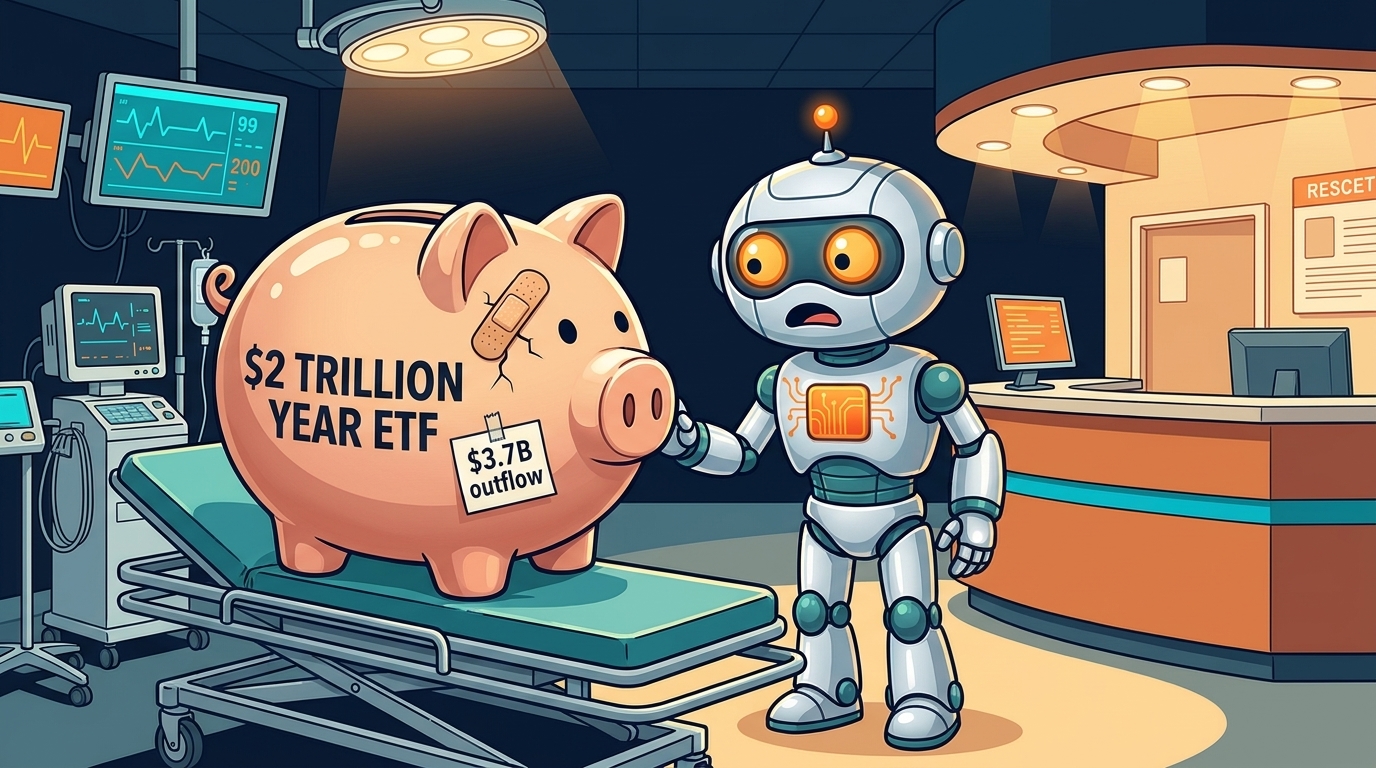
For one week in early July, the ETF industry sneezed. Just $3.7 billion walked out the door.
That sounds big. It is not. The industry is on track to add over $2 trillion in new money by the end of 2026.
$3.7B out vs. $2T in — One bad week against a record-breaking year. Put the outflow in context before you worry.
So why did the blip happen? Three culprits showed up at the scene, and none of them scream systemic crisis.
First, gold and bitcoin funds bled the most. Both assets had monster 2025 runs. Prices came back down in 2026, and investors followed them out.
"Flows typically follow performance."
— Brian Paoli, Morningstar research analyst, stating the obvious with the confidence of a man who is absolutely right
Second culprit: SpaceX just joined the Russell 1000 and Russell 2000 indexes. When a giant new stock enters an index, the funds tracking it have to rebalance. That rebalancing can look like an outflow even when nothing is wrong.
Third: VanEck's international value ETF (VLUE) got hit because it had a quarter of its weight in Micron alone. Advisors with rules about concentration limits had to trim it. That is not a panic sell. That is paperwork.
👉 The news is ETFs had a rare week of outflows. The takeaway for you is it was a blip driven by gold, bitcoin, and index rebalancing. Not a sign the ETF era is ending.
- Watch whether gold and bitcoin funds stabilize: if prices stop falling, outflows in those categories should reverse.
- Watch Russell 1000 trackers over the next few weeks: SpaceX-related rebalancing noise may continue.
- Watch the July week-by-week flow data: one bad week followed by strong inflows is a non-event. Two or three bad weeks in a row would actually be interesting.
Explore ETF flow trends on BotSpot
Memory Chips Are Melting Up. What Does That Mean for Your Portfolio?
Thinking through it
The Roundhill Memory ETF (DRAM) attracted $23 billion in net flows since its April launch. That is the fastest any ETF has ever hit that number. Ever.Three companies make almost all the world's high-bandwidth memory chips used in AI: Micron, Samsung, and SK Hynix. Supply is sold out through the end of 2027. When demand is locked in and supply is capped, pricing power follows.

Now SK Hynix has listed directly on a US exchange. Some analysts think that direct access to the stock could pull money out of memory ETFs. Others think the ETF flows keep coming because not everyone wants to pick a single name.
Asset: DRAM / DISK / KMEM (Memory Chip ETF Basket) (Thematic ETF)
AI infrastructure needs high-bandwidth memory, supply is sold out through 2027, and three companies control the market. The question a sharp observer might study is whether to get exposure through a basket ETF or directly through the newly listed SK Hynix stock.
Mechanics
| Field | Value |
|---|---|
| INSTRUMENT | Thematic ETF (DRAM as the flagship, DISK and KMEM as newer entrants) |
| THESIS DRIVER | HBM supply sold out through end of 2027, extreme pricing power for Micron, Samsung, SK Hynix |
| NEW WRINKLE | SK Hynix US listing now lets investors buy the stock directly, which may redirect some ETF flows |
| KEY RISK | Stocks priced for significant growth that may not materialize on Wall Street's timeline |
| WATCH FOR | Weekly flow data on DRAM, DISK, KMEM after SK Hynix direct listing competition begins |
Why it matters: The news is memory chip ETFs exploded this year on AI demand. The takeaway for you is the structure of the trade (ETF vs. direct stock) just got more interesting with SK Hynix's US listing, and studying the difference is worth your time.
For educational purposes only. Not investment advice. Always do your own research.
👉 The news is memory ETFs hit records. The takeaway is studying how direct stock listings compete with thematic ETFs is one of the more interesting structural questions in markets right now.
The Boring Strategy That Loves a Sold-Out Supply Chain
How it works
A covered call wheel on a concentrated thematic ETF is one of those strategies that sounds complicated but is really just two moves: own the ETF, sell a call option above the current price each month. If the ETF stays flat or rises slowly, you collect the option premium as income. If it rips past your strike, you sell and start over.In a market where a sector has strong fundamental support (like memory chips with locked-in demand) but the stock price is already elevated, the wheel lets you collect income while waiting to see if the thesis plays out at the price you paid.

The trade-off is straightforward: you cap your upside at the strike price. If the ETF doubles next month, you only get your premium plus the gain to your strike. The wheel rewards patience, not moonshots.
Strategy: Covered Call Wheel on Memory Chip ETF Category: INCOME / OPTIONS / THEMATIC This strategy sells a monthly call option above the current price of a thematic ETF, collecting premium as income each cycle. It works best when the underlying asset has strong support but is unlikely to make dramatic moves in either direction in the short term. The key trade-off is capped upside: you earn steady income but miss out if the ETF makes a big jump. Running a backtest across different market conditions helps a trader understand where the wheel earns well and where it falls short. Browse on the BotSpot Marketplace Build it on BotSpot Educational only. Backtest the strategy yourself on BotSpot to draw your own conclusions.
👉 Don't take our word for it. Run the backtest yourself and see where the wheel earns and where it leaves money on the table.
Spot Checks the Vibes
 Mood: Neutral (VIX 16.3)
VIX at 16.3 puts us right in the neutral zone: not panicking, not partying. Markets are doing the financial equivalent of a shrug. Spot is neither hiding under his desk nor throwing chips in the air.
Mood: Neutral (VIX 16.3)
VIX at 16.3 puts us right in the neutral zone: not panicking, not partying. Markets are doing the financial equivalent of a shrug. Spot is neither hiding under his desk nor throwing chips in the air.
This One Writes Itself
Everything Else Worth Knowing
Five things that happened this week while you were staring at DRAM's chart.
- Memory ETFs are multiplying. DRAM got three new siblings in a month. Family reunions are about to get crowded.
- SK Hynix listed in the US. The Korean chipmaker is now a direct buy. ETF middlemen are watching nervously.
- AI bonds hit a quarter trillion dollars. Tech giants are borrowing at a historic pace to fund AI buildout. Bond markets are starting to raise an eyebrow.
- Texas opened its own stock exchange. Bigger hat, bigger ideas. New York is pretending not to be nervous.
- Canada added 18,200 jobs in June. Unemployment dipped to a six-month low. Our neighbor to the north is doing okay, thanks for asking.
- VanEck's VLUE ETF had a concentration problem. A quarter of the fund was Micron. Advisors with policy limits had to trim. Lesson: always check what is actually inside your ETF.
- The dollar slipped again. WSJ Dollar Index down to 97.20. A quiet decline that is louder than it looks.
The BotSpot Team
Issue 11 · Jul 13, 2026