⚔️ The QQQ Fee War Is Actually On
State Street launched a Nasdaq-100 ETF at nearly half the price of QQQ. Spot is watching the scoreboard.
GM, Spotters. This is BotSpot, brought to you by the team behind Lumiwealth. Each week we walk through the market stories worth knowing about, with context, color, and a clear head.
- ⚔️ State Street's new Nasdaq-100 ETF undercuts QQQ by almost half on fees. The era of one firm owning the index is done.
- 🏦 Big banks passed the Fed stress test. JPMorgan and BofA aced it. Spoiler: the test got easier.
- 🧠 Google lost two top AI researchers to OpenAI and Anthropic in one week, wiping out $270 billion in market value.
- 🏅 Micron dropped blockbuster earnings and quietly put the AI skeptics on mute.
- 🛢️ Oil slid back to pre-war levels as tankers start moving through the Strait of Hormuz again.
The QQQ Fee War Is Actually On
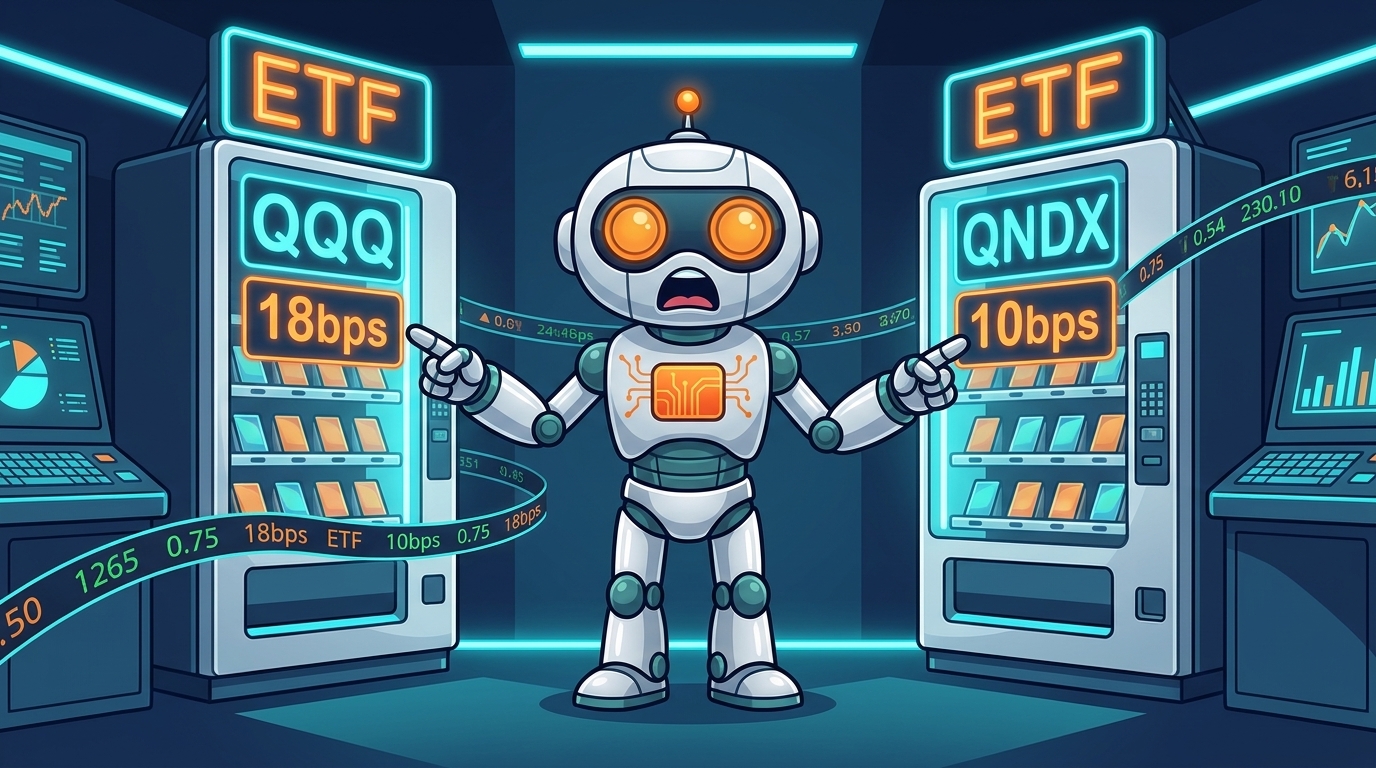
For about 27 years, QQQ had a near-monopoly on the Nasdaq-100 in an ETF wrapper. That era is now officially over.
State Street launched its new Nasdaq-100 ETF (ticker: QNDX) this week at 10 basis points. QQQ charges 18. That is nearly half the price for the same index exposure.
$400 / yr — The annual fee difference on a $500,000 position between QNDX and QQQ. In a tax-deferred account over a decade, that number gets real fast.
This did not happen in a vacuum. BlackRock filed a competing Nasdaq-100 ETF just one day apart from State Street back in April. The industry held its breath waiting for the fee reveal. Now we have it.
One advisor told the Daily Upside a client who had held QQQ since 2017 and never once asked about fees suddenly wanted a full wrapper review this week. SpaceX's IPO started the conversation. State Street and BlackRock are counting on exactly that domino effect.
"The era of one firm owning this index is done."
— Jeff Judge, CFP at Chesapeake Financial Planners
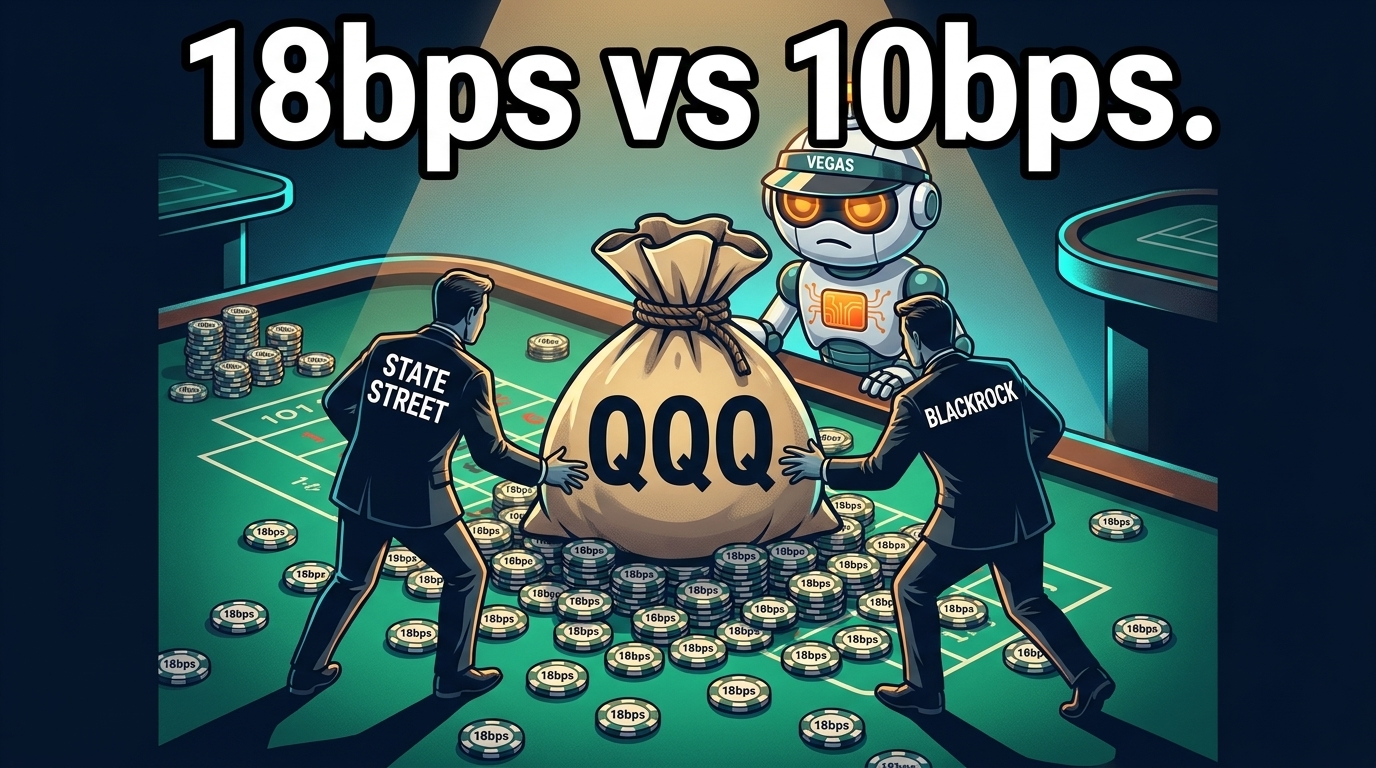 Invesco just saw its moat start draining.
Here is the honest nuance: QQQ is not going away tomorrow. It still has the deepest options market and the most liquidity of any Nasdaq-100 product, and institutional traders will stay there for years.
But for buy-and-hold investors starting a fresh position, the math has shifted. Eight basis points sounds tiny until you run it forward 10 or 20 years inside a Roth or 401(k).
👉 The news is that State Street launched a cheaper Nasdaq-100 ETF at 10 basis points versus QQQ's 18. The takeaway for you is that if you are already holding QQQ, nothing changes today, but if you are opening a new position, the fee comparison is now worth a five-minute look.
- Watch for BlackRock's fee reveal when iShares files its final prospectus. It could go even lower.
- Watch whether Invesco cuts QQQ's fee in response. First-mover advantage is real, but so is price pressure.
- Watch the options market on QNDX. Until it builds volume, QQQ still wins on tactical trades.
- Watch advisor model portfolios. When big wirehouse model portfolios swap QQQ for QNDX, that is when the real assets shift.
- Watch for two more blockbuster tech IPOs later this year. Each one could spark a new wave of index conversations.
Thinking Through the ETF Fee Trade
Thinking through it
When two ETFs track the exact same index but charge different fees, there is an interesting structure worth understanding. It is not about picking a winner on day one. It is about thinking through where price compression tends to flow.
One interesting angle here: when a new, cheaper product launches against a dominant incumbent, the incumbent's price often compresses too. That is what happened when Vanguard entered the S&P 500 ETF space and eventually forced everyone's hand on fees.
Asset: QQQ vs. QNDX fee-compression study (ETF / EQUITY INDEX)
When a cheaper product launches against an entrenched incumbent tracking the same index, fee compression often follows across the entire category. Understanding how this dynamic played out in the S&P 500 ETF space (IVV vs. SPY vs. VOO) could be instructive for thinking about what happens next in the Nasdaq-100 space.
Mechanics
| Field | Value |
|---|---|
| INSTRUMENT | QQQ (18bps) vs. QNDX (10bps), pending iShares Nasdaq-100 ETF |
| STRUCTURE | Same underlying index, different fee structures and liquidity profiles |
| THESIS DRIVER | Fee compression precedent: VOO launched at 6bps in 2010 and SPY cut its fee twice in the years that followed |
| KEY RISK | QQQ's options market depth is a genuine moat; fee alone does not determine which product wins |
| WATCH FOR | Invesco fee response, BlackRock prospectus final fee, advisor model portfolio shifts |
Why it matters: The news is that the Nasdaq-100 ETF space now has real price competition for the first time. The takeaway for you is that understanding how ETF fee wars play out historically is a useful mental model, whether you hold QQQ or not.
For educational purposes only. Not investment advice. Always do your own research.
👉 The structure to study is not which ETF to buy. It is how fee wars tend to end, and who usually wins when two products track the same thing.
The Covered Call Wheel on a Volatile Index
How it works
The covered call wheel is one of the most studied income strategies in retail options trading. You sell a cash-secured put on an ETF like QQQ, get assigned if it drops, then sell covered calls on the shares you now own until you get called away. Repeat.
The interesting question right now is how this structure behaves when a cheaper competitor enters the space and the underlying gets more attention from retail and advisors. More eyeballs on an index can mean more volume and often more options premium to collect.
Strategy: Covered Call Wheel on QQQ Category: INCOME / OPTIONS The covered call wheel on QQQ is a mechanical income strategy where the trader collects options premium whether the index rises, falls, or sits still. The trade-off is that in a strong bull run, the strategy caps your upside because you have sold the right to buy your shares away from you at a set price. It works best in sideways or gently trending markets, and it behaves very differently in high-volatility versus low-volatility environments. Worth backtesting across different VIX regimes to see how the income profile changes. Browse on the BotSpot Marketplace Build it on BotSpot Educational only. Backtest the strategy yourself on BotSpot to draw your own conclusions.
👉 Don't take our word for it. Run the backtest yourself and see how the income profile shifts when VIX is above 20 versus below 15. The numbers will tell you something a summary cannot.
Spot Checks the Vibe
 Mood: Neutral (VIX 17.9)
VIX at 17.9 puts the market right in the middle of the road. Not panicking, not partying. Spot is sitting at his desk, coffee in hand, waiting to see who blinks first.
Mood: Neutral (VIX 17.9)
VIX at 17.9 puts the market right in the middle of the road. Not panicking, not partying. Spot is sitting at his desk, coffee in hand, waiting to see who blinks first.
This Week in Financial Mood Boards
Five More Things Worth Knowing
- Banks passed the stress test. JPMorgan and BofA aced it, but the test got easier this year after the Fed started releasing details in advance. A+ on the open-book exam. Still counts.
- Google lost $270B in two LinkedIn updates. Gemini co-lead Noam Shazeer left for OpenAI. Nobel Prize winner John Jumper left for Anthropic. The most expensive resignation letters since the invention of email.
- Google also joined the Dow. Which is apparently what happens when you go from disruptor to institutional titan. Congrats on your 37th birthday, Alphabet.
- Micron earnings silenced the doubters. Blockbuster quarter, Nasdaq futures popped, Asian semis rallied overnight. AI demand is not a vibe. It is a memory chip.
- Gold slipped below $4,000. Rate-hike bets are the culprit. Gold does not love the idea of rates going up. Neither does your mortgage.
- Oil is back to pre-war levels. Tankers are moving through the Strait of Hormuz again. Supply fears ease, price falls. Simple as pasta night.
- Bezos wants to sell you a $25K electric truck. No radio. No built-in nav. Hand-crank windows. 160,000 reservations. The Model T energy is real.
The BotSpot Team
Issue 9 · Jun 25, 2026