🧊 Crypto Winter Is Back. Like, Really Back.
Bitcoin ETFs just saw their biggest 30-day outflow ever. Here is what that actually means for your portfolio.
GM, Spotters. This is BotSpot, brought to you by the team behind Lumiwealth. Each week we dig into the market stories worth knowing about, add some context and color, and keep it short enough to read before your coffee gets cold.
- 🧊 Bitcoin ETFs just logged their worst 30-day outflow ever. $6.4 billion gone.
- 📈 Treasury yields are rising again. The Fed is not done making your life interesting.
- 👓 Meta just dropped cheaper smart glasses. Zuckerberg wants wearable AI to be your thing.
- 🏦 The Atlanta Fed still does not have a president. The White House is watching closely.
- 💼 Jobs data drops this week. Markets are holding their breath for clues on rate hikes.
The Bitcoin ETF Party Just Got Rained Out

Not long ago, Bitcoin ETFs were the hottest thing in finance. Everybody wanted in. Advisors were recommending them at dinner parties.
That was then. In the last 30 days, investors pulled $6.4 billion out of spot Bitcoin ETFs. That is the biggest 30-day outflow the category has ever recorded.
$6.4B — Pulled out of Bitcoin ETFs in the last 30 days. The largest single-month outflow since the category launched.
Bitcoin itself has fallen about a third this year and is now trading under $60,000. The iShares Bitcoin Trust (IBIT), which nearly hit $100 billion in assets last October, is now running at roughly half that size.
So what broke? Three things hit at once. Rates are expected to keep climbing, and higher rates are historically bad for assets like Bitcoin. Money is rotating toward AI stocks, especially with SpaceX joining public markets and Anthropic and OpenAI IPOs on the horizon. And then there are the forced sellers: funds and leveraged positions unwinding automatically, not because of a bearish view but because the math stopped working.
"This is mechanical, non-directional selling. Not a bearish bet. Just math doing math."
— Don Friedman, CEO of Digital Assets Council of Financial Professionals
 Capital is not lost. It just moved to a shinier neighborhood.
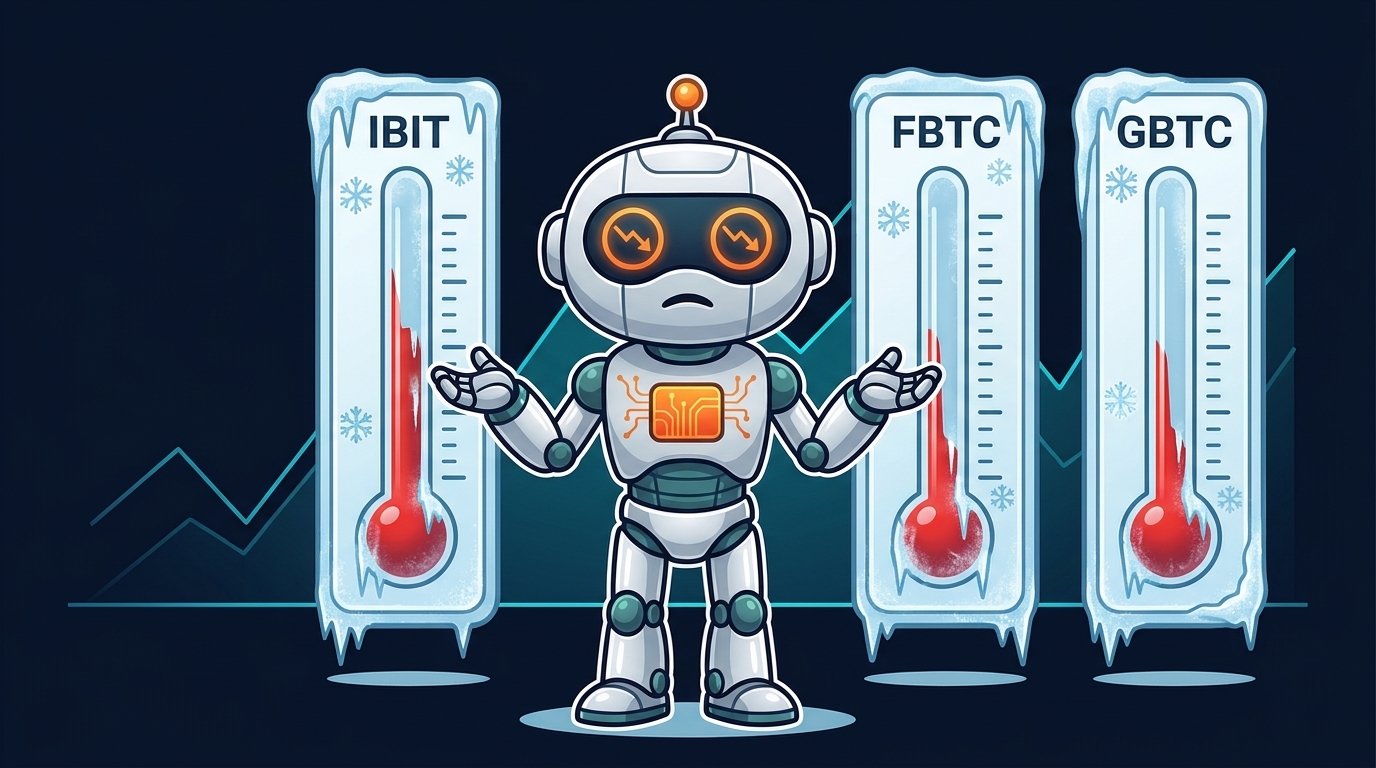
The three biggest Bitcoin ETFs all saw big losses this year. IBIT shed $475 million in assets. Fidelity's FBTC lost $1.6 billion. Grayscale's GBTC dropped $1.9 billion. That is not a rounding error.
Here is the nuance, though. The analysts talking to wealth managers say most advisors who already held Bitcoin are keeping their positions or adding to them on this dip. The ones who never owned it are now considering it as a possible entry point. Winter does not mean dead. It means cold.
👉 The news is Bitcoin ETFs just had their worst month on record. The takeaway for you is this is a structural rotation story, not a Bitcoin-is-over story. Rising rates and AI hype are pulling capital away for now.
- Watch the jobs report this week. A strong number raises the odds of more rate hikes, which adds more pressure on Bitcoin.
- Watch IBIT flows daily. BlackRock's fund is the bellwether. If it stabilizes, the bleeding may be slowing.
- Watch the SpaceX and Anthropic IPO timelines. More AI supply means more competition for growth-hungry capital.
- Watch the $60K level on Bitcoin itself. It has been a psychological line and a technical one.
Analyze crypto vs. rates with AI
What If You Played the Crypto Chill With a Covered Call?
Thinking through it
Crypto winter does not mean you have to sit on your hands. If you already hold a Bitcoin ETF like IBIT and you think prices are going sideways for a while, one structure that traders study is the covered call. You hold the ETF, you sell a call option above the current price, and you collect a premium while you wait.

The logic is simple: if Bitcoin is stuck in a range, the option you sold expires worthless and you keep the premium. The risk is you cap your upside if Bitcoin suddenly rips higher. It is a trade-off between income now and gains later.
Asset: IBIT (iShares Bitcoin Trust ETF) (ETF / Crypto / Options)
If IBIT trades sideways during a crypto winter, selling a covered call above current price collects premium income while the position waits. This is a thought experiment about income generation on a rangebound asset, not a recommendation to trade.
Mechanics
| Field | Value |
|---|---|
| INSTRUMENT | IBIT covered call (own shares, sell call above market) |
| STRUCTURE | Long IBIT shares plus short 1 call option per 100 shares, strike 10-15% above current price |
| THESIS DRIVER | Crypto winter means rangebound price action. Premium income cushions while waiting for a recovery. |
| KEY RISK | If Bitcoin rallies hard, gains above the strike are forfeited. You keep the premium but miss the move. |
| WATCH FOR | Jobs data this week and any Fed signal on rate hikes, both of which would affect Bitcoin vol and your premium. |
Why it matters: The news is Bitcoin ETFs are in a historically bad drawdown and rangebound conditions may persist. The takeaway for you is that covered calls are an educational example of how traders think about generating income on positions they already hold during quiet periods.
For educational purposes only. Not investment advice. Always do your own research.
👉 The covered call is not a magic trick. It is a structured way to think about income versus upside. Worth studying before you need it.
The Boring Strategy That Shines in Crypto Winter
How it works
The TLT Mean Reversion strategy is about as unsexy as it gets. When long-term Treasury bond prices fall far below their recent average, you buy them, expecting them to snap back. When they run well above average, you trim. No crypto, no AI hype, no earnings drama. Just bonds doing what bonds eventually do.

Right now, with rates rising and bond prices getting pushed down, TLT is trading well below its longer-term moving averages. That is exactly the setup this strategy looks for. The trade-off is timing: bonds can stay low longer than you expect, especially when the Fed is still hiking.
Strategy: TLT Mean Reversion Category: MEAN-REVERSION / BONDS This strategy buys TLT when it drops significantly below its 50-day or 200-day moving average and exits when it returns to that average. It is designed for patient traders who believe bond prices eventually revert to their mean after rate-driven sell-offs. The key trade-off is that reversion can take weeks or months in a sustained hiking cycle, requiring patience and a comfortable position size. Browse on the BotSpot Marketplace Build it on BotSpot Educational only. Backtest the strategy yourself on BotSpot to draw your own conclusions.
👉 Don't take our word for it. Run the backtest yourself and see how this structure behaves across different rate cycles.
Spot Checks the Vibe
 Mood: Neutral (VIX 18.4)
VIX at 18.4 means the market is not panicking, but it is also not throwing a party. Think of it as the financial equivalent of a Tuesday afternoon: calm, slightly suspicious, waiting for something to happen.
Mood: Neutral (VIX 18.4)
VIX at 18.4 means the market is not panicking, but it is also not throwing a party. Think of it as the financial equivalent of a Tuesday afternoon: calm, slightly suspicious, waiting for something to happen.
We All Felt This
Five Things Before You Go
- Bitcoin is down a third this year. The halving was supposed to fix this. The halving did not fix this.
- Treasury yields are rising again. The dollar weakened on Iran diplomacy hopes, which is a sentence that means something in 2026.
- The Atlanta Fed still has no president. The search restarted after the first round of finalists did not pan out. The White House is watching. No formal role, apparently just vibes.
- Meta's smart glasses now cost $300. That is $80 cheaper than before and $500 less than the fancy ones. Kylie Jenner is the marketing strategy. We are not making this up.
- Jobs data drops this week. A strong number raises the case for more rate hikes. A weak number raises the case for drama. Either way, Spot is watching.
- Kevin Warsh is not Alan Greenspan. Greenspan was famously cryptic. Warsh is tight-lipped in a different way. Mortgage markets are already charging you a premium for the uncertainty.
- A Philippine fintech is going public. Ant-backed, targeting $1.5 billion. The biggest IPO in Philippines history. Somewhere, a Goldman analyst is very excited about a road show.
The BotSpot Team
Issue 9 · Jun 29, 2026