🌶️ The CPI Print That Changed Goldman's Mind
Inflation ran hot, Goldman rewrote its Fed forecast, and the Nasdaq bounced back the next morning. Classic market whiplash, explained.
GM, Spotters. This is BotSpot, brought to you by the team behind Lumiwealth. Each week we dig into the stories shaping markets and hand you the context a sharp trader actually needs.
- 🌶️ Hot CPI data just made Goldman Sachs pencil in more Fed tightening. We break it down.
- 🤖 CoreWeave earnings lit up AI optimism again and Nasdaq futures bounced hard the next morning.
- 💵 The dollar hit a four-week high. A 50bp hike could push it even further.
- 🏛️ One Fed voter is pushing for gradual hikes. That word 'gradual' is doing a lot of heavy lifting.
- 📈 Spot is watching the idea of the week: a rate-sensitive options structure worth understanding right now.
Goldman Flipped Its Fed Call. Here Is What That Actually Means.
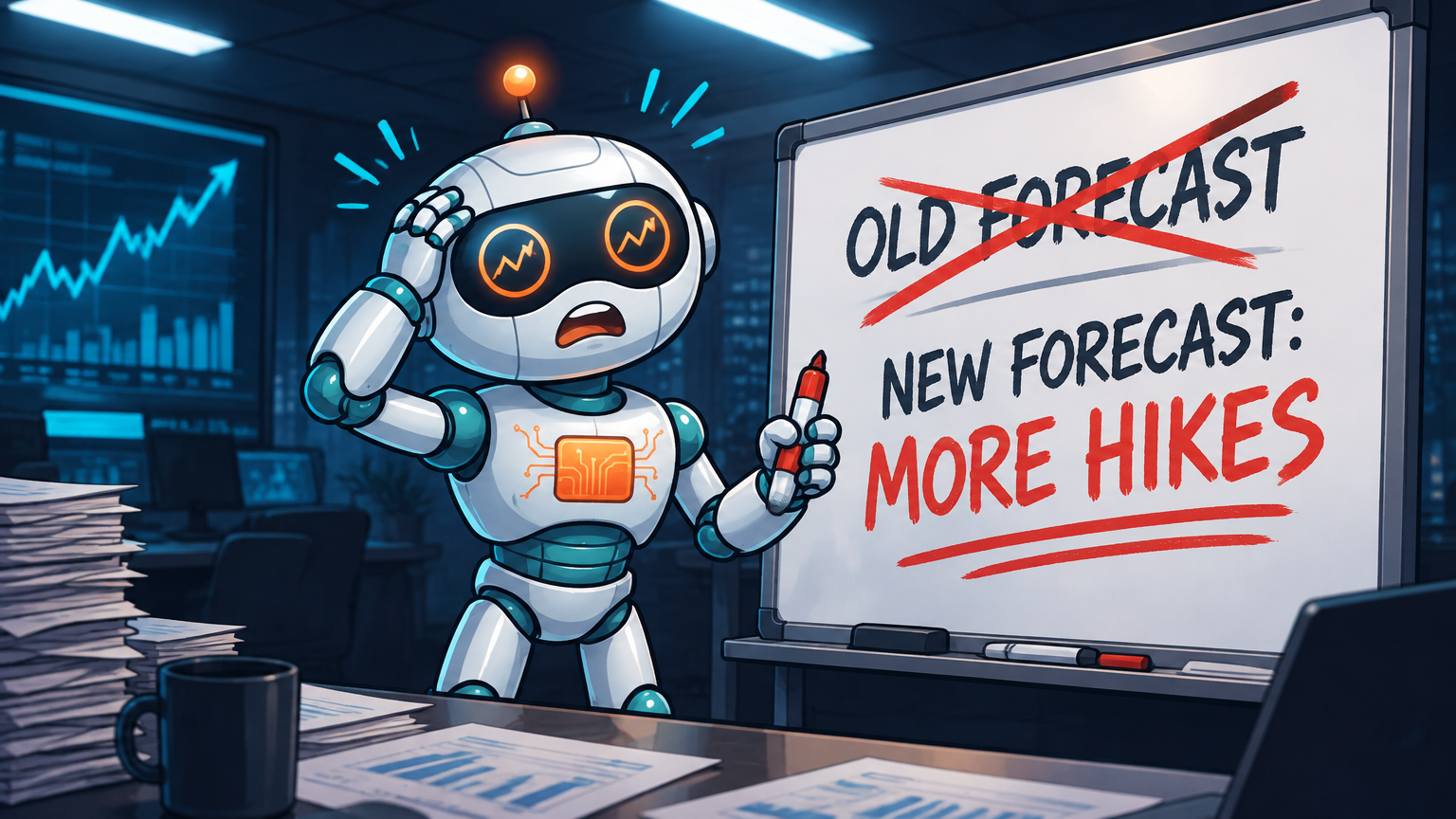
Tuesday's CPI report came in hotter than expected. Goldman Sachs picked up its pencil and rewrote its entire Federal Reserve forecast.
That is the kind of pivot that makes the whole market stop scrolling. When Goldman changes its call, traders listen whether they want to or not.
4-week high — Where the dollar index climbed after the CPI print. The currency market said the quiet part loud.
Here is what happened in plain English. Inflation came in above where the Fed wanted it. Goldman looked at that number and decided it had been too optimistic about rate cuts arriving soon.
The bank is now pencilling in additional tightening. That means higher rates for longer, which is the market's least favorite four-word phrase after 'your margin call is processing.'
"She expects more tightening to come. But prefers to do it gradually. The word 'gradually' is now the most important word in finance."
— Fed Governor Paulson, paraphrased without mercy
 Goldman Sachs, also at that diner, just asked for the manager.
The twist is what happened the morning after. Nasdaq futures rallied. AI optimism from CoreWeave's earnings report walked in and punched rate-hike fear right in the face.
CoreWeave posted solid cloud-computing results and European chip stocks jumped in sympathy. The market decided AI momentum was bigger news than one CPI print. For one morning, anyway.

This is the tension every Spotter should understand heading into year-end. The Fed is leaning hawkish again. The market keeps finding reasons to look past it. One of them will blink first.
👉 The news is Goldman just upgraded its Fed tightening forecast after a hot CPI print. The takeaway for you is that the 'rate cuts are coming' trade has gotten more complicated, and the dollar's move is confirming it.
- Watch the next CPI release. One hot print made Goldman flip. Two in a row would pressure the whole market.
- Watch the dollar index. A move toward 50bp hike pricing would push it higher and pressure gold, international stocks, and growth names.
- Watch AI earnings. CoreWeave just showed that strong cloud results can override macro fear, at least for a session.
- Watch Fed Governor language. 'Gradual' is still the operative word for now. If that changes, so does everything else.
When the Fed Talks Tough, TLT Gets Interesting
How to think about it
When Goldman changes its Fed forecast and the dollar jumps, one instrument almost always moves in sympathy: TLT, the long-bond ETF. Rates up means bond prices down, and TLT is the simplest proxy for that relationship.The interesting wrinkle right now is that TLT has already sold off a lot. That means it is either a falling knife or a coiled spring, depending on how the next few CPI prints land.

One structure traders study in this environment is a put spread on TLT: defining the downside if rates keep rising, while keeping the premium cost manageable. It is an educational example of how to think about rate exposure with a defined risk.
Asset: TLT (iShares 20+ Year Treasury Bond ETF) (OPTIONS / TREASURIES)
If the Fed tightens more than expected, long bond prices fall further. A put spread on TLT is one way traders study defined-risk exposure to that scenario without buying puts naked.
Mechanics
| Field | Value |
|---|---|
| INSTRUMENT | TLT put spread (buy lower strike put, sell even lower strike put) |
| STRUCTURE | Debit put spread, 30-45 days to expiration |
| THESIS DRIVER | Goldman raising Fed tightening forecast; hot CPI data; dollar at 4-week high |
| KEY RISK | If CPI cools, TLT rallies and the spread expires worthless |
| WATCH FOR | Next CPI release and any Fed speaker shift away from 'gradual' |
Why it matters: The news is Goldman just pencilled in more Fed tightening after a hot CPI print. The takeaway for you is that understanding how a put spread on TLT works gives you a framework for studying defined-risk rate exposure, regardless of whether you trade it.
For educational purposes only. Not investment advice. Always do your own research.
👉 The idea is not 'sell bonds.' The idea is understanding how a two-leg options structure lets you define exactly how wrong you can be before you lose everything.
The Boring Strategy That Actually Loves Rate Spikes
How it works
The TLT Mean Reversion strategy watches for extreme price drops in long-term Treasuries, then looks for a bounce back toward the average. The logic is simple: bonds do not go to zero, and when the market overshoots its rate panic, they snap back.The trade-off is timing. Mean reversion sounds easy until you are sitting in a losing position for three months waiting for the Fed to blink.

The strategy is worth studying right now because TLT has already moved a long way from its recent average. Whether that makes it a great setup or a trap is exactly the kind of question a backtest helps answer.
Strategy: TLT Mean Reversion Category: MEAN-REVERSION / TREASURIES This strategy buys TLT when it trades significantly below its moving average and exits when it recovers toward that average. The natural trade-off is that 'below average' can keep going lower when the Fed is in a sustained hiking cycle. Running the backtest across different rate environments helps you see when the strategy thrives and when it grinds you down. Browse on the BotSpot Marketplace Build it on BotSpot Educational only. Backtest the strategy yourself on BotSpot to draw your own conclusions.
👉 Don't take our word for it. Run the backtest yourself and see what a sustained hiking cycle does to a mean-reversion thesis on bonds.
Spot Is Reading the Room
 Mood: Neutral (VIX 18.6)
VIX at 18.6 means the market is nervous but not screaming. Goldman flipped its forecast, CPI ran hot, and yet Nasdaq bounced. That is what 'neutral' feels like in 2026.
The Market on Tuesday vs. The Market on Wednesday
Five Things Before You Close This Tab
- Goldman changed its Fed forecast. One hot CPI print and the whole model gets a rewrite. Must be nice to have that kind of pencil.
- CoreWeave saved the Nasdaq's Tuesday. Solid cloud earnings walked in and calmed everyone down. AI optimism is apparently never more than one earnings beat away.
- The dollar hit a four-week high. More rate hike bets mean a stronger dollar, which means your international ETF is having a rough November.
- Fed Governor Paulson said 'gradual.' She wants more hikes but wants them slowly. 'Gradual' is doing the heaviest lifting of any adjective in America right now.
- SEC enforcement hit an 18-year low. One billion dollars in penalties, the lowest since 2008. The watchdog is apparently on a nap schedule.
- NYSE is settling tokenized stocks on a blockchain. The New York Stock Exchange chose Avalanche for its 24/7 trading platform. No one asked if the blockchain was ready for 24/7 volatility.
- KKR and RWE bet $16B on U.K. wind. Offshore wind in the North Sea, two of the largest projects ever. Apparently someone still believes in infrastructure that takes ten years to build.
The BotSpot Team
Issue 29 · Nov 11, 2026