🔥 Jobs Blew Up. Now What Does the Fed Do?
The October jobs report just handed the Fed a problem it did not ask for. 165,000 new jobs. A 57-year low in jobless claims. And a December hike that is now 80% priced in.
GM, Spotters. This is BotSpot, brought to you by the team behind Lumiwealth. Each week we walk through the market stories worth knowing about, with context, color, and a robot named Spot who refuses to stay calm about it.
- 💼 165,000 jobs added in October. That is nearly triple what Wall Street expected. The Fed just got louder.
- 🤔 AI may be both the reason the economy is hot AND the reason it cools down. Only in 2026.
- 🕵️ Nvidia CEO Jensen Huang is under investigation. Shares fell 5% premarket. Spot is not okay.
- 💉 Moderna is up 760% this year. COVID is somehow still printing money. Wild.
- ⚡ Berkshire's Pacific Power wants a 57% electric rate hike in California. That is $120 more a month.
The Jobs Report Gave the Fed Exactly What It Did Not Want
The economy added 165,000 jobs in October. Wall Street expected 59,000. That is not a beat. That is a demolition.
Traders went from a 66% chance of a December rate hike on Thursday to 80% by Friday afternoon. One jobs report. One day. That is how fast the math moves.
57-year low — Weekly jobless claims hit their lowest point since 1969 the same week. The labor market is not cooling. It is not even looking for sunscreen.
But here is the twist: the same force making the economy run hot may also be the thing that slows it down. We are talking about AI, obviously, because when are we not.
EY's chief economist says AI investment drove half of US GDP growth since last year. Goldman's chief economist says the contribution is basically zero. Both are very confident. Only one can be right.
"Continued falls in tech stocks and oil prices could eliminate the prospect of an additional hike in early 2027."
— Matthew Martin, Oxford Economics, writing a note nobody wanted to read on a Friday
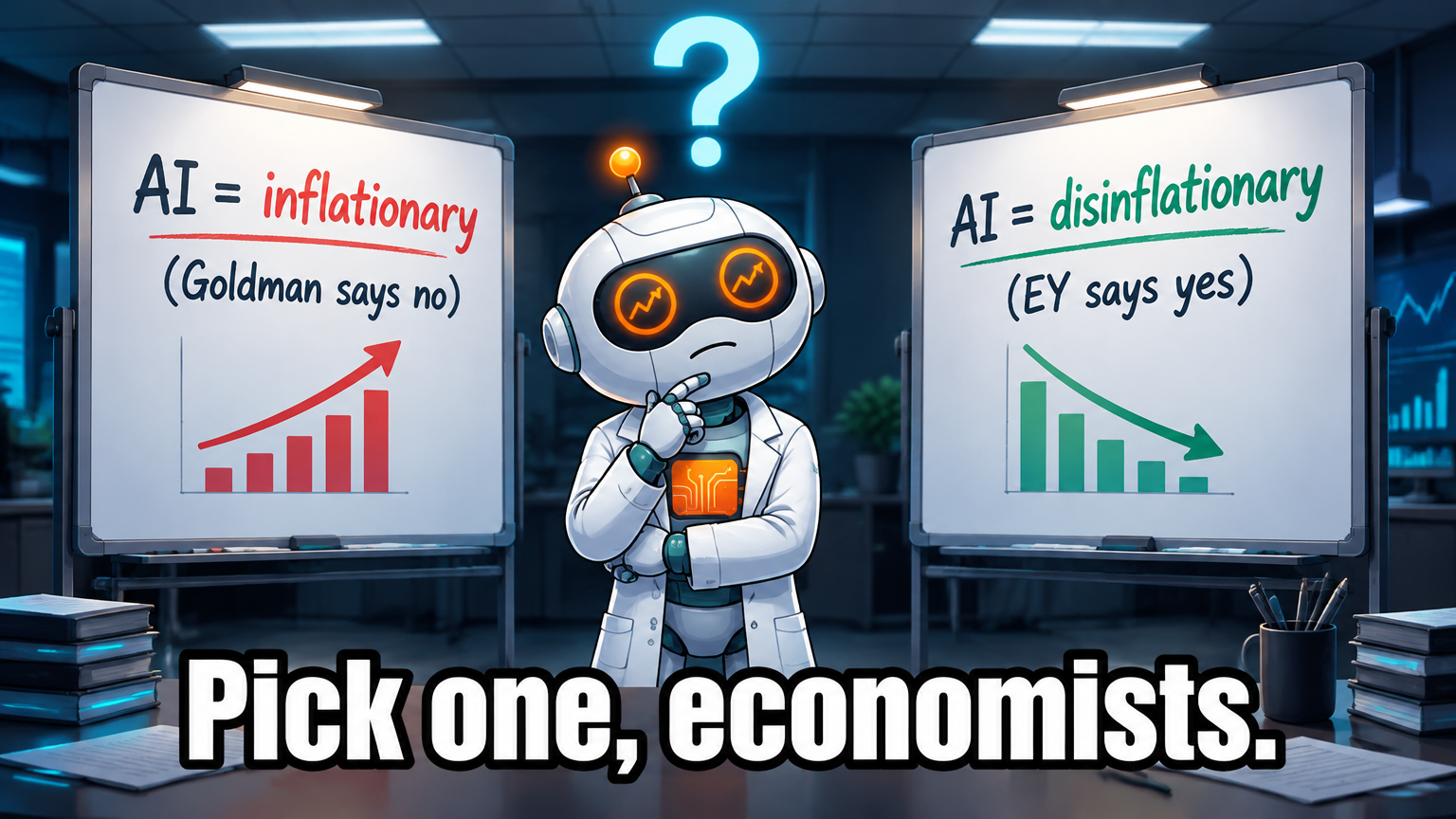 The Fed is also confused. They just have a bigger podium.
The logic goes like this: the AI buildout is pushing up energy and hardware prices right now. That is inflationary. But if tech stocks keep selling off and spending slows, that pressure could ease on its own. The Fed would not need to hike again.
Meanwhile, the robots are not eating anyone's job yet. Unemployment is 4.1%. Job openings per unemployed person actually went up in September. White-collar hiring at law firms and consulting firms stayed strong last month.

👉 The news is the jobs market is way hotter than expected. The takeaway for you is a December rate hike is now the base case, which puts pressure on rate-sensitive trades heading into the last FOMC of the year.
- Watch Tuesday's CPI report. It is the last big data drop before the December FOMC meeting and it could either lock in the hike or give the Fed a reason to pause.
- Watch tech stocks. A continued selloff could do the Fed's job for it, reducing the need for another hike in December or January.
- Watch the productivity number next quarter. At 3.6% annualized, AI's impact is still marginal. If it jumps, the inflation story changes fast.
- Watch rate-sensitive sectors like utilities, REITs, and long-duration bonds. They feel a December hike before anyone else.
When the Fed Hikes Into a Strong Jobs Market, Treasuries Get Interesting
Thinking through it
When the market moves from 66% to 80% odds of a December hike overnight, bond traders start doing math fast. Short-duration Treasuries reprice. Long-duration bonds feel the squeeze from the other direction. The gap between 2-year and 10-year yields becomes a story of its own.

The thought experiment here is about how a hot jobs report reshapes the yield curve. It is not a new idea. But the specific setup of AI-driven inflation plus an 80% December hike odds makes the short end of the curve the interesting place to study this week.
Asset: 2-Year Treasury ETF (SHY) vs. 20-Year Treasury ETF (TLT) (Fixed Income / ETF)
As a thought experiment: when December hike odds surge, the short end of the yield curve tends to reprice faster than the long end. Studying how SHY and TLT move differently in this environment is an educational look at how rate expectations work in practice.
Mechanics
| Field | Value |
|---|---|
| INSTRUMENT | SHY (1-3yr Treasuries) and TLT (20yr+ Treasuries) |
| STRUCTURE | Observing relative price movement as short rates are repriced for a December hike |
| THESIS DRIVER | Short-end Treasuries react fastest to near-term Fed rate expectations |
| KEY RISK | CPI on Tuesday could swing the whole picture before December FOMC |
| WATCH FOR | Any Fed governor comments softening December hike language |
Why it matters: The news is the December rate hike is now 80% priced in. The takeaway for you is understanding how the short end (SHY) versus long end (TLT) of the Treasury market responds differently to that pricing is a core piece of rate-environment literacy every options trader should have.
For educational purposes only. Not investment advice. Always do your own research.
👉 The news is the yield curve is repricing in real time. The takeaway is that watching SHY vs. TLT this week is a live classroom in how rate hikes travel through the bond market.
The Boring Strategy That Actually Loves Rate Hikes
How it works
A covered call wheel on a short-duration bond ETF like SHY is about as exciting as watching paint dry. You hold the ETF, you sell a call above the current price, you collect the premium, you repeat. The strategy does not need the price to go up. It just needs the price to not fall off a cliff.

In a rising rate environment, short-duration bond ETFs tend to be more stable than long-duration ones because they mature and reset faster. That relative stability is exactly what a covered call wheel is looking for. The options premium is the whole game here, not capital appreciation.
Strategy: Covered Call Wheel on SHY (Short-Duration Treasuries) Category: INCOME / OPTIONS The covered call wheel on a short-duration bond ETF is a strategy designed to generate steady premium income in a range-bound or slowly rising rate environment. You sell covered calls on a position you hold, collect the premium, and repeat each expiration cycle. The trade-off is that you cap your upside if the ETF rallies sharply, and you still face downside if rates move dramatically against you. The strategy rewards patience and low drama, which makes it worth studying in weeks like this one when the bond market is noisy. Browse on the BotSpot Marketplace Build it on BotSpot Educational only. Backtest the strategy yourself on BotSpot to draw your own conclusions.
👉 Don't take our word for it. Run the backtest yourself and see how the premium income changes across different rate environments.
Spot Checks the Vibes
 Mood: Fear (VIX 23.5)
VIX at 23.5 puts us firmly in Fear territory. The jobs report spooked rate traders, Nvidia slid on the Huang investigation, and nobody wants to be the last one holding long-duration bonds heading into December FOMC. Spot is not panicking. But Spot is also not sleeping great.
The Fed's December Calendar in One Image
Five Things Before You Go
- 165,000 jobs. Wall Street expected 59,000. The economy did not get the memo about slowing down. The memo is now on fire.
- December hike odds jumped to 80% overnight. One jobs report moved the needle 14 points. That is the market telling you something is priced wrong somewhere.
- Nvidia's Jensen Huang is under investigation. Shares fell 5% premarket. The accusation involves a relationship with an exec suspected of working for Chinese intelligence. This one has legs.
- Moderna is up 760% this year. COVID vaccines still printing money. Analysts have an average price target implying 44% downside. The market and the analysts are not in the same room.
- Berkshire's utility wants a 57% rate hike in California. Pacific Power is asking for $120 more a month on the typical residential bill. Buffett once called utilities boring. California has entered the chat.
- AI is not killing white-collar jobs yet. Law firms and consulting shops added workers in October. The robots are still mostly writing first drafts and annoying people in Slack.
- Tuesday's CPI report is the last big variable. If inflation surprises hot on top of this jobs number, December is a lock and January is in play. If it cools, the Fed has a reason to breathe.
The BotSpot Team
Issue 28 · Nov 9, 2026