🏦 The Week AI Ate the News (And the Jobs)
AI earnings disappointed, banks blocked robot bankers, and Barclays handed pink slips to 5,000 people. All in one week.
GM, Spotters. This is BotSpot, brought to you by the team behind Lumiwealth. Each week we walk through the market stories worth knowing about, with context, color, and a clear head.
- 🤖 AI stocks slid after earnings disappointed. SpaceX saved the week. Barely.
- 🏦 Barclays cut 5,000 jobs and pointed at AI. The Fed has opinions on that.
- 🇫🇷 French bond spreads hit their widest since 2011. Europe is quietly having a moment.
- 🚫 Citi and BofA are blocking AI agents from touching client money. Smart? Scared? Both?
- 📈 Goldman, JPMorgan, and Morgan Stanley pulled in $52B in equities revenue. Hedge funds want more.
AI Promised the Future. This Week It Cost 5,000 Jobs.

This week, AI delivered bad earnings, cracked French bonds helped rattle markets, and Barclays announced it was cutting 5,000 jobs because, you guessed it, the robots can handle it.
Three separate stories. One overlapping theme. The AI hype cycle is now colliding with the AI reality check, and markets felt every bump.
5,000 jobs — What Barclays cut this week, about 5% of its entire workforce, citing AI for back-office automation. That is not a rounding error.
Barclays is not alone. This is the quiet part that everyone is saying out loud now. Banks are profitable, AI is the reason, and headcount is the price.
Separately, AI earnings from several tech names disappointed investors this week. The SpaceX relief rally on Wednesday helped, but it was more of a band-aid than a cure.
"AI is replacing the back office. The front office is funding the AI bets. Nobody is sure which one blows up first."
— Spot, reading the room
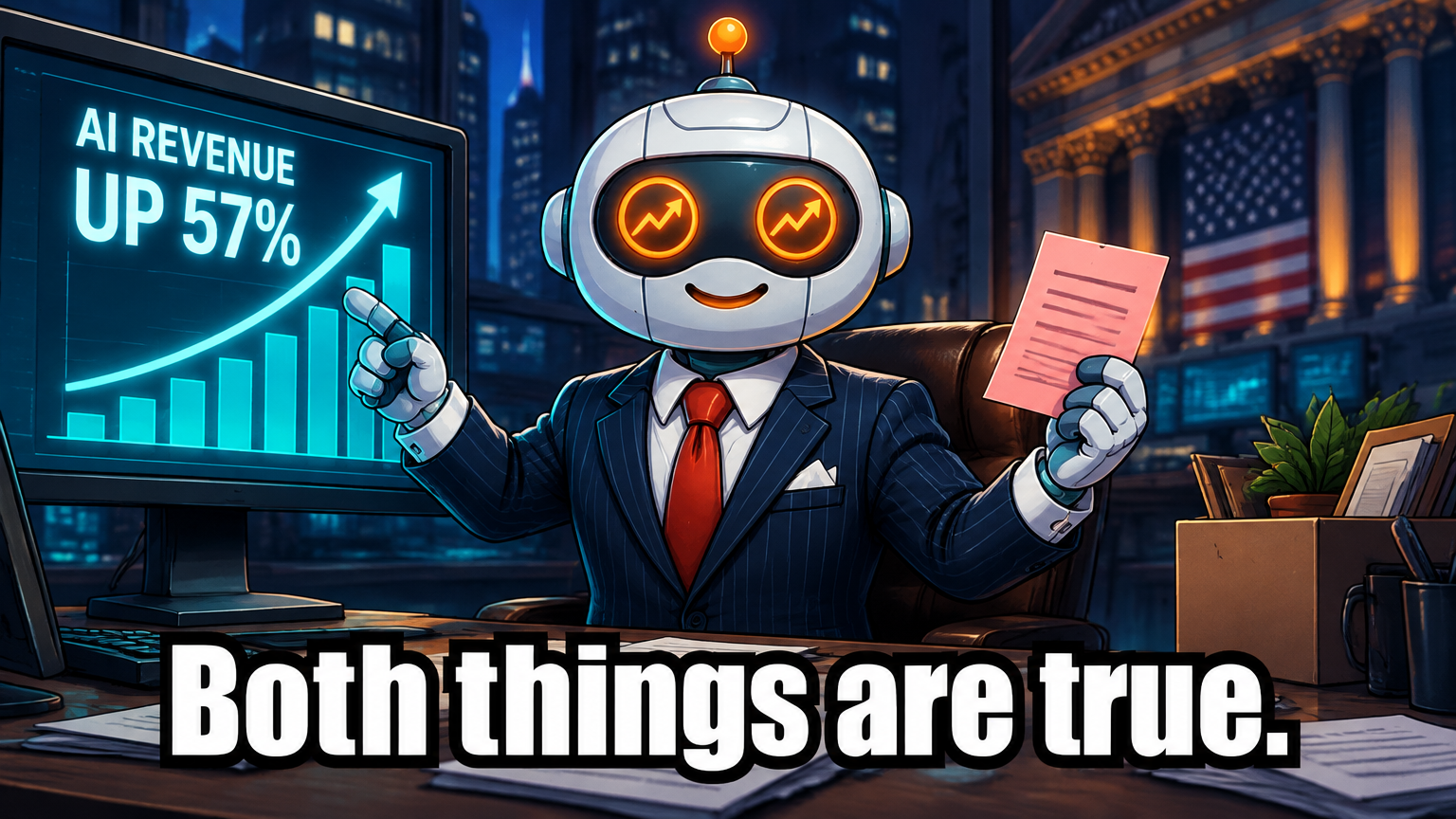
Here is the real tension. Goldman's equities revenue grew 57% this year to more than $19 billion, powered in part by AI financing for hedge funds. Meanwhile, Barclays is using AI to eliminate the humans who used to do the same work at a fraction of the cost.
On top of all that, Citi and Bank of America quietly announced they are blocking AI agents from moving client money without human approval. The headline sounds paranoid. The reason is not. AI fraud is already costing financial firms $5.47 for every dollar lost.
👉 The news is AI is cutting jobs, disappointing on earnings, and getting blocked from bank accounts all in the same week. The takeaway for you is the market is starting to price the gap between AI promise and AI delivery, and that gap matters for every tech-heavy portfolio.
- Watch AI earnings calls closely for any language around 'delayed revenue' or 'longer sales cycles.' That is code for 'we oversold it.'
- Watch French bond spreads. They hit the widest since 2011 this week. European stress has a way of washing onto US shores slowly, then suddenly.
- Watch what hedge funds do with tech exposure. Goldman's prime brokerage data showed them dumping tech at the fastest pace in a decade last week. That is a signal worth tracking.
- Watch bank AI policy announcements. If more banks follow Citi and BofA in restricting AI agents, that is a ceiling on agentic AI revenue growth in financials.
Playing Defense When AI Disappoints
Thinking through it
When AI earnings disappoint and the sentiment shifts from 'must own' to 'show me the money,' tech-heavy indexes like QQQ often see bigger swings than the broader market. That price swing difference between QQQ and SPY is the interesting variable here.

One structure that traders study in this kind of environment is a long SPY versus short QQQ spread, sometimes expressed through options. The idea is simple: if AI names drag the Nasdaq harder than the broader market, the spread widens in SPY's favor.
Asset: SPY vs. QQQ Spread (Long SPY / Short QQQ) (ETF / OPTIONS)
When AI sentiment cools, the Nasdaq 100 tends to fall harder than the S&P 500 because QQQ is more concentrated in large-cap tech. This thought experiment explores whether the spread between SPY and QQQ widens during AI earnings disappointment cycles, and what a protective structure around that divergence might look like as an educational example.
Mechanics
| Field | Value |
|---|---|
| INSTRUMENT | SPY calls / QQQ puts, or cash long SPY vs. short QQQ |
| STRUCTURE | Long SPY exposure, short QQQ exposure, equal notional (spread trade) |
| THESIS DRIVER | AI earnings disappointments hitting QQQ harder than SPY given higher tech concentration |
| KEY RISK | AI names recover faster than expected, or a broad macro shock hits both equally |
| WATCH FOR | QQQ/SPY ratio breaking below its 50-day moving average as a potential signal |
Why it matters: The news is AI earnings are disappointing and tech-heavy indexes are more exposed. The takeaway for you is understanding how the QQQ vs. SPY spread works is useful context for anyone who holds both, because it shows how sector concentration changes your risk even when you think you are 'diversified.'
For educational purposes only. Not investment advice. Always do your own research.
👉 This is an idea to study, not a signal to act on. The interesting question is whether SPY's lower tech concentration makes it a structural buffer when AI narrative shifts. Worth researching with your own data.
The Boring Strategy That Loves Volatility Spikes
How it works
The TLT Mean Reversion strategy watches for moments when long-term Treasury bond prices get knocked down hard, often during equity sell-offs, then bets on them bouncing back toward their average. Bonds and stocks often move in opposite directions during fear spikes, so when equities get hit, Treasuries tend to catch a bid.

The trade-off is real. Mean reversion works beautifully until it does not. If rates keep rising instead of snapping back, the strategy takes repeated small losses. Sizing and stop rules matter as much as the entry signal.
Strategy: TLT Mean Reversion on Fear Spikes Category: MEAN-REVERSION / TREASURIES This strategy buys TLT (the 20-plus-year Treasury ETF) when it drops sharply over a short window, typically 3 to 5 days, on the hypothesis that it will revert toward its recent average. It tends to be more active during equity volatility spikes, like the kind we saw this week when AI earnings disappointed. The core trade-off is that it rewards patience during fear cycles but struggles in sustained rising-rate environments where bonds keep falling. Running your own backtest across different rate regimes is the only way to see which periods it works in and which it does not. Browse on the BotSpot Marketplace Backtest it on BotSpot Educational only. Backtest the strategy yourself on BotSpot to draw your own conclusions.
👉 Don't take our word for it. Run the backtest yourself and see how this strategy behaves across calm markets versus the kind of AI-driven volatility we had this week.
Spot Checks the Vibes
 Mood: Neutral (VIX 18.1)
VIX at 18.1 puts us squarely in Neutral territory. Markets are not panicking, but they are not throwing chips in the air either. AI earnings disappointments and French bond jitters have traders watching the door without running for it yet.
Relatable Content for the Algorithm-Adjacent
Five Things Spot Noticed
- SpaceX saved the week. Strong earnings from Elon Musk's rocket company sparked a chip-stock rally on Wednesday. Nvidia said thank you.
- French bonds are the new drama. The spread between French and German 10-year yields hit its widest since 2011 this week. Paris has entered the chat.
- Goldman had a very good year. Equities revenue up 57% to $19 billion. Hedge funds are hungry, and Goldman is the kitchen.
- Banks are locking out AI agents. Citi and BofA are blocking AI tools from moving client money. The undo button does not exist on a wire transfer.
- Hedge funds dumped tech. Goldman's prime brokerage desk says hedge fund tech selling hit the fastest pace in at least a decade last week. Their net leverage hit a one-year low.
- The jobs report was soft. 50,000 jobs added in December. Not the disaster number, not the relief number. The shrug number.
The BotSpot Team
Issue 26 · Oct 22, 2026