🦈 Sharks Borrow Billions. Guppies Pray.
The AI debt market just hit a record $300B, and Elon Musk is calling out 200+ companies for what he calls 'guppy-level death.' Here is what that actually means for your portfolio.
GM, Spotters. This is BotSpot, brought to you by the team behind Lumiwealth. Each week we unpack the market stories worth knowing, with context, color, and a clear head so you can think like a quant even if all you hold is SPY and a few options.
- 🦈 AI debt just smashed a record. The sharks are fine. The guppies? Not so much.
- 🏦 The Fed is sitting in an 'awkward spot' and Kevin Warsh wants everyone to just be quiet about it.
- 🥇 Gold fell ahead of the Fed meeting. Investors are in a wait-and-see mood.
- 🤖 Anthropic's IPO filing hit the tape and chip stocks across Europe popped. One name is standing out: AMD.
- 📊 Spot is watching the credit default swap market. Weekly volumes just tripled. That is not nothing.
The AI Debt Machine Just Broke a Record
US companies have borrowed $1.76 trillion in investment-grade bonds this year. That beats the pandemic record from 2020. And AI alone is responsible for $300 billion of it.
That is not a typo. Three hundred billion dollars in high-grade AI debt, and we have not even hit Halloween yet. Spot is calling it: the debt party is getting sorted by who can actually pay the bill.
$300B — High-grade AI debt raised in 2026 so far. That is triple all of 2025. In ten months.
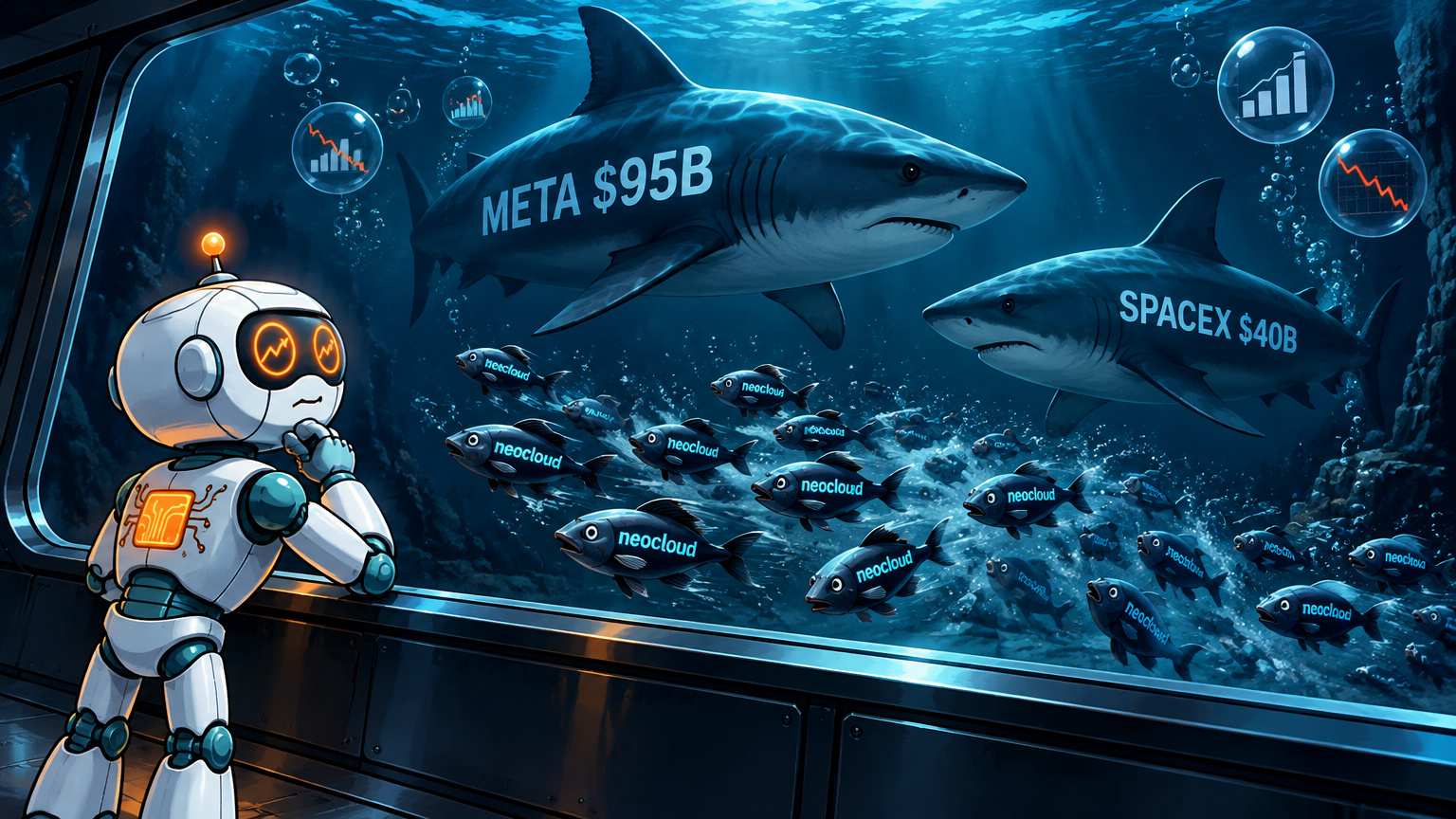
Elon Musk posted over the weekend that debt markets have 'almost entirely shut off access' for companies that do not have real revenue outside of AI data centers. He predicted 200-plus smaller cloud companies face 'guppy-level death and consolidation.' Then SpaceX went and borrowed $40 billion anyway. Classic.
Meta made it official too, announcing a $95 billion financing plan through stock offerings to keep building out its AI infrastructure. When the biggest fish in the ocean need $135 billion between them in a single week, you start to understand why the smaller players are sweating.
"Debt markets have almost entirely shut off access to money for any company that doesn't have substantial revenue independent of AI data centers."
— Elon Musk, posted on X, while simultaneously borrowing $40 billion
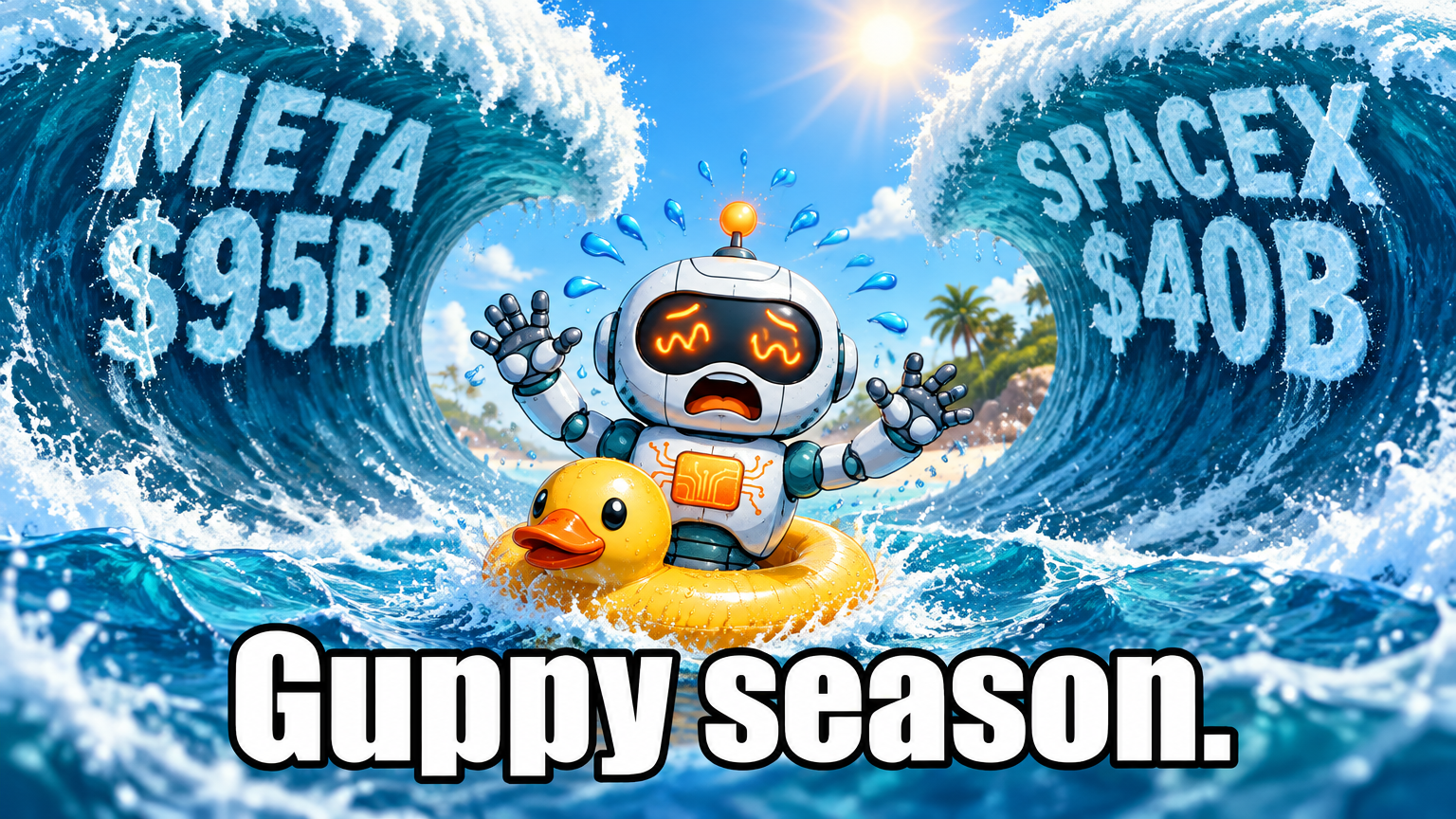 Two hundred-plus neoclouds are feeling this right now.
Morgan Stanley analysts put it plainly: higher borrowing costs are splitting AI into two camps. The four hyperscalers (Amazon, Alphabet, Meta, Microsoft) can absorb higher interest rates. Everyone else is getting squeezed out of the pool.
Here is the number that really caught Spot's eye: investors bought more than $9 billion per week in credit default swaps in September on bonds from the big AI names. In July, that number was $2 billion. CDS volume on the whole index already exceeds all of last year's total. That is the bond market quietly buying insurance at a rapid pace.
👉 The news is AI borrowing just hit a record $300B and the debt door is closing for smaller players. The takeaway for you is that if you hold tech ETFs or individual AI-adjacent names, concentration in the four hyperscalers is not just smart, it is what the bond market is quietly telling you.
- Watch credit default swap volumes weekly. A spike means the bond market is hedging faster than the stock market is noticing.
- Watch the neoclouds: CoreWeave, Lambda Labs, and similar names are exactly the 'guppies' Musk flagged. Debt access is their oxygen.
- Watch Meta and Alphabet earnings this week. Both have $90-plus billion capex plans to justify. The market will have questions.
- Watch the Fed this week. Higher rates for longer makes every one of those $300B in AI loans more expensive to roll over.
Idea of the Week
Thinking through it
Gold fell this week as investors sat on their hands ahead of the Fed meeting. When the Fed is uncertain, gold tends to wobble. But when the Fed eventually tips its hand, gold usually makes a sharp move in one direction.
The interesting structure here is not a directional bet on gold. It is a way to think about playing the uncertainty itself, using options on GLD (the gold ETF) before a known catalyst like a Fed announcement.

A long straddle on GLD lets you profit if gold moves sharply in either direction after the Fed speaks. You do not need to guess which way. You just need to believe the move will be bigger than the market expects.
Asset: GLD (SPDR Gold Shares ETF) (Options / Commodities)
The Fed meeting this week is a known event that historically causes sharp moves in gold. A long straddle on GLD is a thought experiment in buying the volatility of that event rather than picking a direction.
Mechanics
| Field | Value |
|---|---|
| INSTRUMENT | GLD options (long straddle) |
| STRUCTURE | Buy one at-the-money call and one at-the-money put, same strike, same expiration (short-dated, 1-2 weeks out) |
| THESIS DRIVER | Fed meeting this week is a known volatility catalyst for gold. The straddle profits if GLD moves more than the premium paid, in either direction. |
| KEY RISK | If gold barely moves after the Fed, both legs lose value. Time decay works against you fast with short-dated options. |
| WATCH FOR | Implied volatility in GLD options before the Fed. High IV means the straddle is expensive. Low IV means it may be a bargain. |
Why it matters: The news is gold is treading water ahead of a Fed decision that nobody can predict confidently. The takeaway for you is that event-driven options structures like straddles are worth understanding as a way to study how traders express uncertainty rather than conviction.
For educational purposes only. Not investment advice. Always do your own research.
👉 The news is gold options get interesting before Fed meetings. The takeaway is understanding straddles teaches you to think about events, not directions.
The Boring Strategy That Loves Fed Drama
How it works
The Covered Call Wheel on SPY is about as exciting as watching paint dry. You sell a put, get assigned shares if the price drops, then sell covered calls on those shares until you get called away. Then you start over. That is the whole thing.
The reason it becomes interesting in a week like this one is that implied volatility on SPY tends to tick up around Fed meetings. Higher implied volatility means fatter option premiums when you sell. The wheel collects more income when the market is nervous.

The trade-off is straightforward. If SPY rips higher, you cap your upside because your shares get called away. If SPY crashes hard, you are holding shares at a loss and the premium only softens the blow a little. This strategy does not love violent markets. It loves rangy, nervous markets, which is exactly what a Fed meeting week tends to produce.
Strategy: Covered Call Wheel on SPY Category: INCOME / OPTIONS The Covered Call Wheel sells short-dated puts on SPY, takes assignment if the price drops, and then sells covered calls until shares are called away. It generates income from option premiums rather than relying on price appreciation. The natural trade-off is capped upside on strong rallies and real downside risk in sharp drops. Many traders study it as a way to understand how selling volatility works in practice across different market environments. Browse on the BotSpot Marketplace Build it on BotSpot Educational only. Backtest the strategy yourself on BotSpot to draw your own conclusions.
👉 Don't take our word for it. Run the backtest yourself and see how the wheel behaves in Fed meeting weeks versus quiet stretches.
Spot Reads the Room
 Mood: Neutral (VIX 17.9)
VIX at 17.9 puts us squarely in Neutral territory. The market is not panicking, but it is also not throwing a party. Everyone is waiting for the Fed to say something on Wednesday, and gold already flinched first.
Guppy Season Is Real
Bite-Sized Cookies
- AI debt hit $300 billion this year. Triple 2025's total, and it is not even November. The tab is getting real.
- Kevin Warsh wants the Fed to be quiet. His colleagues are as noisy as ever. The Fed is basically that one group chat you cannot mute.
- The Fed is in an awkward spot. WSJ said it, not us. Last month's rate hike did not even get them back to neutral. Awkward is the right word.
- Gold fell ahead of the Fed meeting. Investors awaiting clarity tend to go to cash. Gold is not cash, but it usually acts like conviction. Right now there is none.
- Anthropic filed IPO paperwork. European chip stocks popped the next day. The AI hype dial still turns on news alone.
- AMD stands out as AI gets more fractured. When the field splits, the shovel-sellers sometimes do better than the gold miners. Classic.
- CDS volumes on AI bonds are up 4x since July. The bond market is buying insurance quietly while the stock market scrolls headlines. One of them is usually right.
The BotSpot Team
Issue 27 · Oct 27, 2026