⚡ The Fed Held. Oil Did Not. ⚡
Rates stayed put, two Fed officials voted to hike anyway, oil cracked $115, and Microsoft made Alphabet look like a science fair loser. Busy Wednesday.
GM, Spotters. This is BotSpot, brought to you by the team behind Lumiwealth. Each week we dig into the market stories worth actually caring about, with context, color, and zero filler.
- 🏦 Fed holds rates steady, but two officials voted to hike. December is not cancelled.
- 🛢️ Oil topped $115 a barrel on the same day. The Fed's headache just got a new flavor.
- 🪟 Microsoft Azure grew 48% year over year. Alphabet's free cash flow went negative. Wall Street noticed.
- ⚡ GE Vernova dropped $9 billion on a grid equipment maker. The AI power trade just got louder.
- 🌍 ECB meeting up next. European bond yields already falling in sympathy with the Fed.
The Fed Held Steady. Everything Else Did Not.

On Wednesday, the Federal Reserve looked at inflation, looked at $115 oil, looked at two of its own officials screaming for a hike, and said: nah, we're good.
The Fed held rates unchanged. Two officials, Governor Lisa Cook and Cleveland Fed President Beth Hammack, voted against the hold and wanted a rate increase instead. That kind of internal split is rare enough to notice.
$115 — Price per barrel of oil on the same day the Fed held rates. Two inflationary forces. One very sweaty December outlook.
Fed Chair Kevin Warsh said something almost impossible to parse: higher rates are slowing the AI investment boom, AND growth is broadening beyond the AI boom. Both things. At once. In the same press conference.
That is a polite way of saying the Fed has no idea which dial to turn. The market heard it as "no hike today" and stocks stayed mostly higher. The Nasdaq slipped into the red anyway, just to keep things interesting.
"Higher rates are slowing the boom. Also, growth is broadening beyond the boom. Also, we are not moving rates."
— Kevin Warsh, basically, at Wednesday's presser
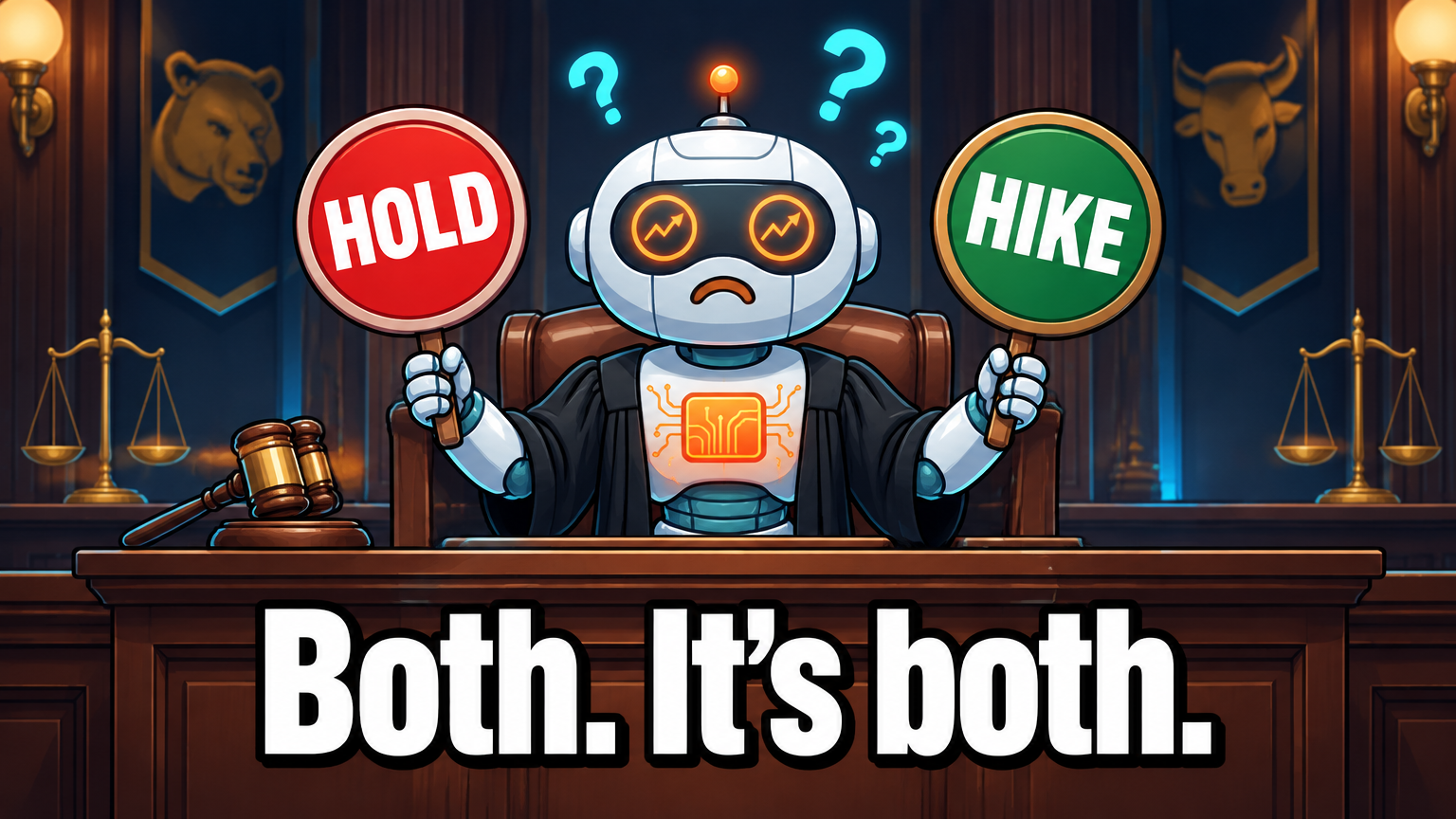 Two dissenters. One held rate. Zero clarity.
The two dissenters are the real story here. When two Fed officials break from the group and vote to raise rates, they are sending a signal: inflation is not done. December is the next live meeting, and a hike there is still very much on the table.
Add $115 oil to the mix and the Fed's job gets harder. Oil is a tax on every American household and every company that ships anything. It feeds directly into the inflation numbers the Fed watches most closely.

👉 The news is the Fed held but two officials wanted a hike and oil just hit $115. The takeaway for you is December is the real decision: watch whether oil stays elevated and whether the dissenter count grows.
- Watch the dissenter count at the December meeting. Two is notable. Three would be alarming.
- Watch oil. If it stays above $110 into November, the inflation story gets harder for the Fed to ignore.
- Watch Treasury yields. They fell after the hold, but that can reverse fast if December hike odds climb.
- Watch the ECB decision coming up next. If Europe cuts while the US eyes a hike, the dollar gets interesting.
When Oil Spikes and the Fed Freezes
How to think about it
When oil runs hot and the Fed is frozen, energy stocks and inflation-sensitive bonds tend to move in opposite directions. That gap is the interesting part for a trader thinking about structure, not just direction.

The classic thought experiment here involves putting something energy-related on one side of the ledger and something rate-sensitive on the other. Not as a prediction, just as a framework to stress-test your existing SPY exposure against an oil-inflation scenario.
Asset: XLE vs TLT (ETF Pair / Macro)
If oil stays above $110 and December hike odds climb, energy ETFs (XLE) may benefit from the inflation trade while long-duration Treasuries (TLT) face continued pressure. The spread between the two widens in that scenario, and that spread is what makes the structure interesting to study.
Mechanics
| Field | Value |
|---|---|
| INSTRUMENT | XLE (energy ETF) vs TLT (20+ yr Treasury ETF) |
| STRUCTURE | Long XLE / observe TLT as the rate-sensitivity hedge in a portfolio context |
| THESIS DRIVER | Oil above $110 + two Fed dissenters + December hike risk = inflation trade re-engages |
| KEY RISK | Oil reverses sharply, recession fears spike, and both legs move against the scenario |
| WATCH FOR | December Fed meeting odds via CME FedWatch, weekly EIA oil inventory data, 10-year Treasury yield direction |
Why it matters: The news is oil hit $115 the same day the Fed held and two officials voted to hike. The takeaway for you is that the energy-vs-rates tension is worth understanding in the context of how your existing portfolio responds to an oil-driven inflation spike.
For educational purposes only. Not investment advice. Always do your own research.
👉 Worth thinking about: energy and duration often move like a seesaw when oil spikes. Understanding that relationship is a useful mental model before December's Fed decision lands.
The Boring Inflation Hedge That Actually Works
How it works
The commodity momentum strategy is simple: each month, look at a basket of commodity ETFs (oil, gold, agricultural, industrial metals), buy the ones trending up, avoid the ones trending down. No forecasting required. Just follow what is already moving.

The natural trade-off is that momentum strategies can whipsaw badly when a commodity spikes and then reverses fast. Oil at $115 one month and $90 the next is exactly the kind of environment that tests whether the entry timing matters as much as the signal itself.
Strategy: Commodity ETF Momentum Rotation Category: MOMENTUM / INFLATION HEDGE This strategy rotates monthly into the commodity ETFs showing the strongest recent price momentum and out of the laggards. It is designed to catch sustained commodity trends like an oil rally while avoiding the dead weight of whipsawing assets. The main trade-off is that it reacts to what already happened, so it can be slow entering a new trend and slow exiting a reversal. It works best when commodity moves are driven by structural demand (like AI power needs or supply constraints) rather than short-term news spikes. Browse on the BotSpot Marketplace Build it on BotSpot Educational only. Backtest the strategy yourself on BotSpot to draw your own conclusions.
👉 Don't take our word for it. Run the backtest yourself. The interesting part is how the strategy behaves in the months right after a big oil spike.
Spot Checks the Vibe
 Mood: Neutral (VIX 17.1)
VIX at 17.1 says the market is not panicking, but it is not exactly relaxed either. Two Fed dissenters and $115 oil will do that to you. This is the market equivalent of smiling through a dentist appointment.
The One That Found Us First
The Rest of the Week, In One Scroll
- Two officials voted to hike. Lisa Cook and Beth Hammack broke from the pack. December just got more interesting than anyone planned.
- Oil topped $115 a barrel. Same day the Fed held. The irony was not lost on anyone with a gas tank or a portfolio.
- Microsoft Azure grew 48%. Free cash flow came in at $18.6 billion, more than double analyst estimates. The adults are in the room and they run the cloud.
- Alphabet's free cash flow went negative. Negative $9.1 billion. Shares fell more than 10% after hours. The search giant is searching for a narrative.
- GE Vernova bet $9 billion on grid gear. Orders up 96% year over year. Backlog sitting at $197 billion. Turns out the AI trade is really an electricity trade.
- European bond yields fell ahead of the ECB. French OATs outperformed. The ECB meeting is next. Everyone is waiting to see if Europe blinks first.
- Warsh said two contradictory things. Higher rates are slowing growth AND growth is broadening. He said both. On purpose. In public.
The BotSpot Team
Issue 27 · Oct 29, 2026