🤖 AMD Just Joined the $1 Trillion Club
Meta's Muse agent launched. AMD's stock went up 30%. Lisa Su is now planning to spend tens of billions more. Welcome to the agentic era.
GM, Spotters. This is BotSpot, brought to you by the team behind Lumiwealth. Each week we walk through the market stories worth knowing, with context, color, and a clear head so you can think sharper without the noise.
- 🤖 AMD hit $1 trillion in market cap after Meta's Muse AI agent took off. Spot is very excited about this.
- 💼 Jobs came in at 50,000 for December. Not a disaster, but not a party either.
- 🏦 Fed chair Kevin Warsh wants markets to ignore the Fed. His own lieutenants made that impossible last week.
- 📈 S&P and Nasdaq futures pulled back after record highs, even as bond yields kept creeping up.
- 🌍 AMD's CEO is touring Asia and promising to spend tens of billions on supply chain. She is not messing around.
The Agentic Era Has a New $1 Trillion Member

On September 8, Meta launched Muse. In the 29 days since, AMD's stock went up 30% and crossed $1 trillion in market value. That is not a coincidence.
Muse is Meta's AI agent, and it scored 5 million downloads in just 22 days. That's faster than ChatGPT, faster than Claude, and roughly as fast as Pokémon Go. For AMD, every one of those downloads is a customer for the chips that make agents think and act.
$300B — The projected market size for agentic AI by 2030, up from $29B today. Citi's analyst used that number to justify bumping AMD's price target to $800.
Here's the thing most people miss about AI agents. They use GPUs to think, just like a large language model does. But when they actually do something, like booking a flight or clearing your inbox, they lean on CPUs. AMD makes both. Nvidia makes great GPUs. AMD makes great GPUs AND the CPUs agents need to act. That's the angle.
Citi analyst Atif Malik raised his price target from $575 to $800 this week. CEO Lisa Su told reporters in Taipei that the AI run will last for years, and that AMD will substantially increase supply in 2027. She also just agreed to buy World Labs, a startup that builds 3D virtual environments from a few images, for $8 billion. The company was founded by Fei-Fei Li, widely known as the Godmother of AI.
"The AI run will last for years."
— Lisa Su, AMD CEO, Taipei, October 2026 (no hedging, no qualifiers, just the statement)
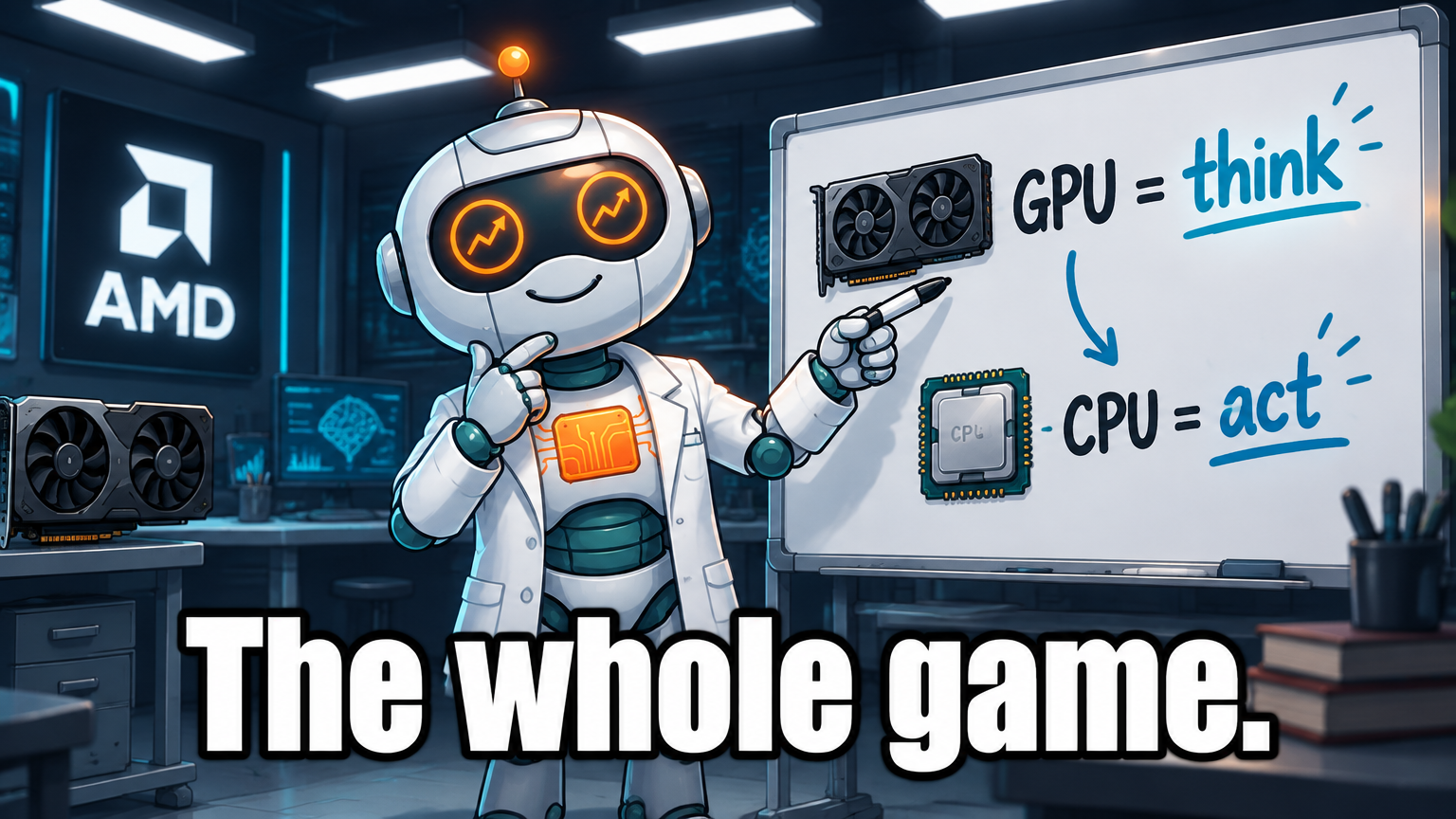 Nvidia gets the thinking credits. AMD wants the acting credits too.
The risk here is real competition. Nvidia launched its Vera CPUs specifically to target the agentic market. Arm, the chip architecture company, could capture 50 to 75 percent of agentic CPU market share according to Wolfe Research. AMD is not running away with this one. It's a three-way race on a track that keeps getting longer.
Still, Muse's growth rate is the number to watch. The app that accelerated AMD's stock 30% in a month did it with zero hardware sales, just software usage that flows downstream into chip demand. OpenAI also just launched Dots, an always-on agent platform. More agents means more compute. More compute means more AMD.

👉 The news is AMD just hit $1 trillion on the back of agentic AI demand. The takeaway for you is that the CPU part of the AI stack, not just GPUs, is now a serious story worth watching.
- Watch Muse download growth month over month. The faster it scales, the stronger AMD's demand case.
- Watch AMD's 2027 supply guidance. Su promised a substantial increase. Analysts will hold her to it.
- Watch what Nvidia does with Vera CPUs. If Nvidia locks up agentic CPU share, AMD's thesis gets messier.
- Watch the World Labs integration. An $8 billion bet on 3D world models is either genius or very early.
Analyze the chip race with Spot
Playing the Agentic AI Wave Without Betting the House
Thinking through it
AMD just crossed $1 trillion and a Citi analyst set a target of $800. That is a big move and a big number. The question a careful thinker asks is: how do you get exposure to the agentic AI theme without putting all your chips on one stock that has already run 30%?

One structure worth studying is a paired approach: a long position in the semiconductor ETF (SMH) for broad chip exposure, combined with a covered call on AMD itself if you already hold shares. The ETF spreads the risk across the whole sector. The covered call brings in income while AMD consolidates after its big run. That is the basic idea to think through, not a recommendation to act on it.
Asset: SMH (VanEck Semiconductor ETF) + AMD covered call (ETF / Options)
If agentic AI is a multi-year theme as Lisa Su says, the whole semiconductor sector benefits. Holding SMH captures that broadly, while an AMD covered call can generate income on a stock that has already run hard and may consolidate near-term.
Mechanics
| Field | Value |
|---|---|
| INSTRUMENT | SMH (long exposure) + AMD covered call (if you hold AMD) |
| STRUCTURE | Long ETF for sector breadth; sell covered call on existing AMD position at a strike above current price |
| THESIS DRIVER | Agentic AI TAM growing from $29B to $300B by 2030; AMD CPU role in agents differentiates it |
| KEY RISK | AMD rallies past the call strike and you miss the upside; Nvidia Vera CPUs or Arm take AMD's market share |
| WATCH FOR | Muse monthly active user data, AMD 2027 supply updates, Nvidia Vera CPU launch timing |
Why it matters: The news is AMD and the whole chip sector are pricing in a massive agentic AI buildout. The takeaway for you is that understanding how a covered call can reduce cost basis on a stock that has already surged is a useful structure to study, whatever you decide to do.
For educational purposes only. Not investment advice. Always do your own research.
👉 The news is AMD ran 30% in a month. The takeaway is that covered calls are a structure worth studying when a stock you hold has surged and you want to think about managing that position.
The Boring Strategy That Keeps Showing Up
How it works
The SMH momentum and mean-reversion overlay is a two-part strategy. First, you watch whether the semiconductor ETF is above or below its 50-day moving average. When it crosses above, momentum says stay in. When it falls below and then bounces, mean-reversion says that might be a re-entry point. The strategy alternates between riding trends and buying dips, depending on which signal is louder.

The natural trade-off is simple: momentum signals get you in late and out late, which means you give back some gains at the top and bottom. Mean-reversion signals can catch knives if the sector is in a genuine downtrend, not just a wobble. Using both together is the attempt to balance those two failure modes. Whether it works depends entirely on the time window and how you define the signals, which is exactly why you run a backtest yourself.
Strategy: SMH 50-Day Momentum + Mean-Reversion Overlay Category: MOMENTUM / MEAN-REVERSION This strategy watches the semiconductor ETF relative to its 50-day moving average and switches between a trend-following mode and a dip-buying mode depending on price action. The appeal is that it tries to avoid sitting in a falling sector while also catching recoveries early. The trade-off is that switching rules add complexity and can generate false signals during choppy, sideways markets. It is a structure worth building in BotSpot's AI agent and running across different market periods to see how often the switches pay off. Browse on the BotSpot Marketplace Build it on BotSpot Educational only. Backtest the strategy yourself on BotSpot to draw your own conclusions.
👉 Don't take our word for it. Run the backtest yourself and see how the signal switches held up across different market conditions.
Spot Checks the Vibe
 Mood: Greed (VIX 15.6)
VIX at 15.6 means the market is comfortable but not delirious. Futures pulled back from record highs this morning, yields are creeping up, and oil prices jumped, but nobody is panicking. Spot calls this the 'second cup of coffee' mood: alert, slightly wired, not yet spilling anything.
Mood: Greed (VIX 15.6)
VIX at 15.6 means the market is comfortable but not delirious. Futures pulled back from record highs this morning, yields are creeping up, and oil prices jumped, but nobody is panicking. Spot calls this the 'second cup of coffee' mood: alert, slightly wired, not yet spilling anything.
This One Writes Itself
The Week in Small Bites
- AMD bought the Godmother of AI. World Labs, founded by Stanford's Fei-Fei Li, is now AMD's for $8 billion. Lisa Su called Li a 'great friend.' The most expensive friend in recent memory.
- Jobs came in at 50,000. Consensus was 55,000. October and November were both revised down. The economy has added 93,000 jobs in eight months total. That is not a typo.
- Warsh wants you to watch the economy, not the Fed. His lieutenants then stepped in to guide rate expectations. The Fed cannot stop talking about the Fed. Classic.
- S&P and Nasdaq futures retreated after record highs. Yields up, oil up, futures down a little. The market shrugged. It has been doing a lot of shrugging lately.
- Lisa Su is spending tens of billions in Asia. Taiwan and South Korea tour, supply chain investments, and a very full calendar. She is not on vacation.
- Muse hit 5 million downloads in 22 days. ChatGPT took 56 days. Claude took 492 days. Muse is either the best AI app ever or we all needed a digital assistant that badly. Possibly both.
- The labor force participation rate fell to 62.4%. Fewer people looking for work is not automatically good news. The number to watch is whether that trend reverses in January.
The BotSpot Team
Issue 24 · Oct 7, 2026