🏦 The Bond Market Held Its Breath. Then Bought Anyway.
Yields hit a 24-year high on Wednesday morning. By afternoon, $39 billion in Treasury notes sold out like Taylor Swift tickets. Here is what that actually means for you.
GM, Spotters. This is BotSpot, brought to you by the team behind Lumiwealth. Each week we walk through the market stories worth knowing, with context, color, and a clear head.
- 💨 10-year yields spiked to 5.36%, a level not seen since 2002. Then a $39B auction happened and everyone calmed down slightly.
- 🏛️ Fed minutes from September: yes to another hike this year, but no rush. October is almost off the table.
- 🛢️ Oil jumped past $105 a barrel after a fresh tanker attack. Dow futures did not enjoy the news.
- 📈 The SEC just approved 3x leveraged funds on gold, silver, bitcoin, and oil through a regulatory side door. More on that below.
- 💻 Microsoft and Nvidia teamed up on a $2,600 AI laptop that runs models locally. The internet immediately argued about whether that is worth it.
The Bond Market Held Its Breath. Then Bought Anyway.

Wednesday morning, the 10-year Treasury yield hit 5.36%. That is the highest since 2002. The internet declared a bond market crisis.
By Wednesday afternoon, $39 billion in 10-year notes sold faster than anyone expected. Yields fell back to 5.28% before the closing bell.
2.5% — The share of Wednesday's $39B auction taken by primary dealers (the big banks who buy whatever nobody else wants). The lowest share on record. Investors ate the rest.
Primary dealers are basically the buyers of last resort at Treasury auctions. When their share hits a record low, it means real investors elbowed them out of the way.
James Thorne, chief market strategist at Wellington-Altus, called it directly: "Buyers bid aggressively at current yields, hardly the behavior one would expect from a market anticipating a dramatic further rise in long-term rates."
"That undercuts claims of a buyer shortage."
— James Thorne, Wellington-Altus Private Wealth, said with the confidence of a man who just watched $39B disappear in an afternoon
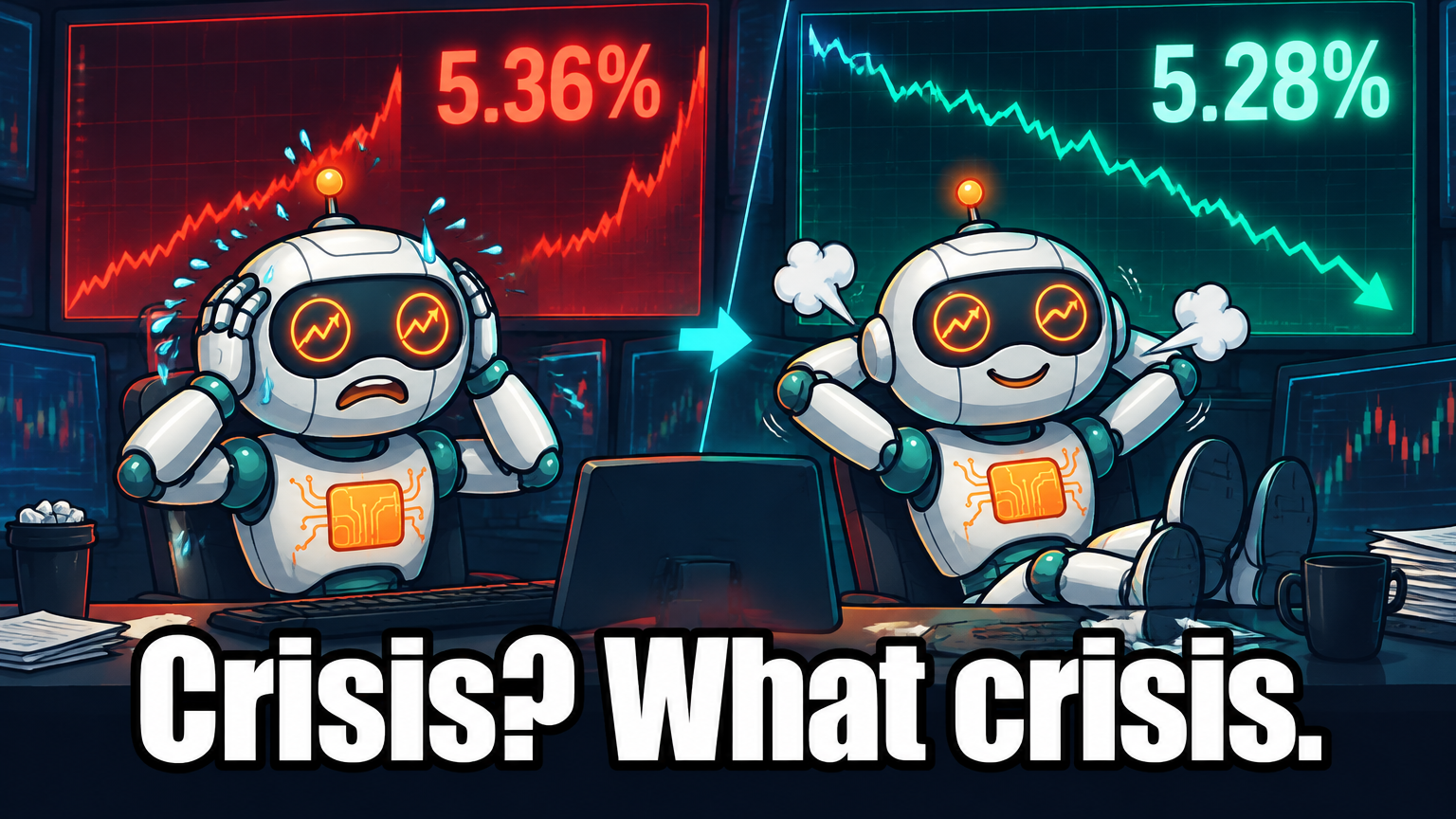 The bond market scared everyone, then did the opposite of what the headlines said.
Here is the part that should get your attention if you hold SPY. The S&P 500 is up about 0.7% over the past month. Sounds fine, right?
Saxo Bank's Charu Chanana points out that only two sectors are actually positive: technology (up 7.1%) and communication services (up 3.3%). Everything else is quietly getting crushed. Financials down 7%, utilities down 6.2%, real estate down 6.1%.
The headline index is fine. The stuff under it is not. Spot is calling it: the damage is hiding behind your Magnificent 7 holdings.

👉 the news is yields spiked to 24-year highs but a blockbuster auction brought them back. the takeaway for you is SPY looks calm on the surface, but most of what is underneath it is quietly hurting from high rates.
- Watch the 10-year yield around 5.3% to 5.4%: that range is where stock investors start rotating into bonds instead.
- Watch which SPY sectors you actually own: tech is carrying the index, everyone else is dragging.
- Watch the October Fed meeting odds: markets price just 17% chance of a hike, but another hot inflation print could change that fast.
- Watch mortgage applications: they fell 4.2% last week with the 30-year rate at 7.49%. Housing stress is a real economy signal.
- Watch the December Fed meeting: the minutes suggest that is the more likely date for any follow-on hike.
When Yields Are Wild, TLT Gets Interesting
How to think about it
When bond yields spike to 24-year highs and then get yanked back by a single strong auction, the price swings in long-duration bond ETFs like TLT get pretty dramatic. That kind of swing is worth understanding as a structure, not just a headline.

The thought experiment here is a defined-risk structure on a heavily rate-sensitive ETF during a period of extreme yield volatility. It is the kind of setup options educators use to teach how protection and premium interact.
Asset: TLT (iShares 20+ Year Treasury Bond ETF) (OPTIONS / FIXED INCOME ETF)
TLT moves sharply when yields swing. A protective collar structure (owning TLT while selling a covered call and buying a put) is a classic example of how traders manage defined risk on a volatile underlying during uncertain rate periods.
Mechanics
| Field | Value |
|---|---|
| INSTRUMENT | TLT (20+ Year Treasury Bond ETF) |
| STRUCTURE | Protective collar: long TLT shares, short OTM call, long OTM put |
| THESIS DRIVER | 10-year yield volatility between 5.28% and 5.36% creates big TLT price swings. The collar caps upside and floors downside. |
| KEY RISK | If yields keep rising (TLT keeps falling), the put provides protection but the call premium may not fully offset the drop. |
| WATCH FOR | Fed minutes language on December hike; CPI prints; primary dealer auction share at next Treasury sale |
Why it matters: the news is TLT swings wildly when yields move between 5.28% and 5.36% in a single session. the takeaway for you is understanding how a collar structure works on a rate-sensitive ETF is a useful building block for any portfolio where bonds matter.
For educational purposes only. Not investment advice. Always do your own research.
👉 the news is TLT is one of the most yield-sensitive ETFs you can buy. the takeaway is understanding how a collar on it works teaches you a lot about managing defined risk in any volatile environment.
The Boring Strategy That Shows Up When Yields Bite
How it works
The TLT mean reversion strategy is simple: when 20-year Treasury yields spike hard and fast, TLT often overshoots to the downside. The strategy buys TLT after a sharp yield spike and exits when price reverts toward a moving average.

The natural trade-off is timing: yield spikes can persist for weeks before reversing, so early entries can sit underwater for a while. The strategy also assumes mean reversion happens, which is not guaranteed when the macro backdrop is shifting.
Strategy: TLT Mean Reversion on Yield Spikes Category: MEAN-REVERSION / TREASURIES This strategy buys TLT after the 10-year yield spikes a set percentage above its recent average, then exits when TLT price recovers toward its 20-day moving average. It is designed for environments where rate moves overshoot and then snap back. The key trade-off is patience: yield spikes can extend before reversing, and position sizing matters a lot when the underlying keeps falling. Browse on the BotSpot Marketplace Build it on BotSpot Educational only. Backtest the strategy yourself on BotSpot to draw your own conclusions.
👉 Don't take our word for it. Run the backtest yourself on BotSpot and see how this held up across different rate environments.
Spot Checks the Vibe
 Mood: Neutral (VIX 16.0)
VIX at 16.0 means the market is not panicking, but it is not throwing a party either. Think of it as your neighbor who just got a speeding ticket: a little shaken, but still driving.
Mood: Neutral (VIX 16.0)
VIX at 16.0 means the market is not panicking, but it is not throwing a party either. Think of it as your neighbor who just got a speeding ticket: a little shaken, but still driving.
The Market in One Image
Quick Bites Before You Go
Five things worth knowing. Read fast, hold longer.
- The 10-year hit 5.36%. Highest since 2002. The bond market had its dramatic moment, then immediately got embarrassed by how fast buyers showed up.
- Fed minutes: December, not October. Officials want another hike this year but see no reason to rush. October odds sit at 17%. December is the main event.
- Oil jumped past $105. A fresh tanker attack sent Brent crude surging and Dow futures sliding. The Middle East premium is back and it brought luggage.
- The SEC approved 3x leveraged funds. Gold, silver, bitcoin, ether, oil, and natural gas can now have 3x ETFs via a regulatory loophole. Retail investors will absolutely not use these responsibly.
- Microsoft built a $2,600 AI laptop with Nvidia. Runs AI locally so your data does not go to the cloud. Reddit is already arguing about whether it is worth it. Classic.
- Mortgage applications fell 4.2%. The 30-year rate hit 7.49%. Would-be homebuyers are watching yields the way the rest of us watch a dentist appointment approach.
The BotSpot Team
Issue 24 · Oct 8, 2026